Top 11 Automated Website Testing Tools, Alternatives and Competitors in 2026
Automated website testing has never been more accessible — or more confusing to choose. In 2026, you can pick from open-source frameworks with millions of GitHub stars, AI-powered no-code platforms, cloud browser grids, and dedicated monitoring tools, all claiming to catch every bug before your users do.
This guide cuts through the noise. We've evaluated 11 of the most widely adopted and discussed automated web testing tools across six criteria — capability, pricing transparency, setup time, team fit, browser coverage, and CI/CD integration — and summarised the results in a single, actionable comparison.
Updated March 2026 with current pricing, feature sets, and real team feedback from G2, Capterra, and community sources.
How We Evaluated Each Tool
Every tool in this guide was assessed against the same six criteria, weighted to reflect what growth-stage and mid-market teams consistently cite as their top priorities:
- Capability depth — Does it cover E2E testing, visual regression, API testing, and scheduling?
- Affordability — Is there a transparent, self-serve pricing path below $100/month?
- Setup speed — Can a developer be running real tests within one working day?
- Non-developer access — Can QA engineers or product managers use it without writing code?
- Cross-browser coverage — Chrome, Firefox, Safari, Edge — how complete is the matrix?
- CI/CD integration — GitHub Actions, webhooks, pipeline triggers?
The 11 Best Automated Website Testing Tools in 2026
1. ScanlyApp — Best Value Web Testing Platform
Category: Managed web testing, visual regression, synthetic monitoring
Starting price: $29/month (free plan available)
ScanlyApp consistently ranks as the highest-value automated web testing platform in the sub-$50/month tier. It combines advanced automated browser scanning with built-in visual regression, flexible scheduling, and an accessible executive summary dashboard that non-developers can operate — without requiring teams to give up test code portability or multi-browser coverage.
Core strengths:
- Cloud-native execution; your scans run against real URLs with real browser sessions
- Visual regression diffing on every run, every plan
- Scheduling modes: cron, on-demand, CI-triggered (webhook)
- Per-project pricing — not per-seat, so team growth doesn't increase costs
- Self-hosted option via Docker for data-sensitive environments
- Executive summary + severity breakdown — every scan, accessible to QA, product, and non-technical stakeholders
- Built-in API testing and Lighthouse performance monitoring alongside browser tests
ScanlyApp is the right choice when:
- You need visual regression and E2E testing consolidated in one tool
- Your team mix includes both developers and non-developers
- You're outgrowing free tools but won't justify $200+/month for Mabl or Testim
- You want portable scan configurations, not proprietary test storage
2. Playwright (Open Source)
Category: Test automation framework
Starting price: Free (Apache 2.0)
Microsoft's Playwright is the most adopted browser automation framework in 2025–2026, surpassing Selenium and Puppeteer in active usage. Its locator API with role-based, text-based, and label-based selectors makes tests inherently more resilient than CSS/XPath-dependent alternatives.
What Playwright does best:
- Full cross-browser support: Chromium, Firefox, WebKit (Safari engine)
- Component testing (experimental)
- Network interception, auth state fixtures, multi-tab flows
- Test Generator (
playwright codegen) for rapid test authoring - Massive open-source community + Microsoft backing
What Playwright doesn't include: Scheduling, cloud execution management, visual regression dashboards, alerting, and reporting are not built-in. Most teams pair Playwright with a cloud execution layer — either ScanlyApp, Microsoft Azure Playwright Testing, or a self-hosted CI runner.
3. Cypress Cloud
Category: E2E test automation (JS/TS frontend focus)
Starting price: Free (500 test results/month), paid from $67/month
Cypress is the leading choice for JavaScript frontend teams, particularly those building React, Vue, and Angular applications. Its in-browser execution model gives tests direct access to the component tree, network layer, and application state — making assertions more reliable and debugging more intuitive than tools that drive the browser externally.
Cypress Cloud adds parallelisation, flake detection, visual diffs (via Cypress's own diffing), and the AI Debugger — which interprets failure screenshots, DOM snapshots, and network logs to generate natural-language failure summaries.
Best for: JS/TS-first teams doing component + E2E testing. Less suited for non-developer QA workflows or multi-language test suites.
4. Mabl
Category: AI-powered no-code/low-code test automation
Starting price: Custom (estimated $200–500+/month)
Mabl's computer vision-based change detection and natural language test authoring represent the state of the art in AI-assisted test automation. Its auto-healing capabilities and deep CI/CD integrations make it well-suited for enterprise QA teams managing large regression suites across multiple applications.
Key limitation: No transparent pricing. Mabl is not self-serve and requires a sales conversation before you can assess total cost of ownership. For teams under ~50 engineers, Mabl is typically over-specified and over-priced.
5. Testim (by Tricentis)
Category: AI-powered self-healing test automation
Starting price: ~$300/month (custom enterprise pricing)
Testim's ML-powered locator engine is its flagship feature: when your UI changes, Testim's algorithms automatically update the affected selectors without developer intervention. The 2024 Tricentis acquisition has pushed Testim's roadmap toward enterprise Salesforce + web UI testing, but it remains capable for general web automation.
Who it's for: Enterprise teams with a dedicated QA automation function who need Salesforce UI test stability and can justify the pricing. Most growth-stage teams will find ScanlyApp, LambdaTest, or Playwright a more proportionate choice.
6. LambdaTest (with KaneAI)
Category: Cloud test execution grid + AI test generation
Starting price: $15/month (automation plans)
LambdaTest has expanded rapidly in 2026 from a pure cross-browser grid into a comprehensive AI-assisted testing platform. KaneAI (natural language to Playwright test conversion), HyperExecute (smart parallel execution), and a 3,000+ real device cloud make it a credible all-in-one platform at a price significantly below Mabl or Testim.
Unique strength: Real physical device testing. If you need iOS Safari testing on actual iPhone hardware (not just WebKit emulation), LambdaTest is one of very few tools that can deliver this.
7. Ghost Inspector
Category: No-code browser test automation + visual regression
Starting price: Free (100 runs/month), paid from $39/month
Ghost Inspector remains the most popular fully no-code, recorder-based test platform for web teams. Its Puppeteer-based execution engine handles most standard E2E flows reliably, and its visual screenshot comparison feature catches layout regressions without any code.
Limitation in 2026: Ghost Inspector runs on Puppeteer, not Playwright. As the industry has converged on Playwright as the standard, Ghost Inspector tests can't be exported to portable Playwright scripts, which creates migration risk. For teams valuing portability, ScanlyApp's Playwright-native execution is a more future-proof choice.
8. Checkly
Category: Synthetic monitoring + API monitoring
Starting price: Free (10k check runs/month), Team at $64/month
Checkly occupies the intersection between synthetic uptime monitoring and full E2E test automation. Its code-first architecture (checks are written as Playwright scripts, stored in your repo) appeals to developer-led teams that want their monitoring as code — observable in git, deployable via CI, reviewable in pull requests.
Core use case: Running lightweight Playwright scripts on a schedule to verify that critical user flows (login, checkout, form submission) work correctly in production — and alerting on failures within seconds.
Not ideal for: Teams that want a no-code interface or comprehensive visual regression. Alternatives to Checkly like ScanlyApp fill the gap between pure monitoring and full QA platform.
9. BugBug
Category: No-code browser test automation
Starting price: Free (unlimited runs, single cloud browser)
BugBug's unlimited-runs free plan is exceptional value for small teams and agencies. It's the fastest tool on this list to set up — a Chrome extension-based recorder captures test flows in minutes. The free plan's single-browser limitation (Chrome only) is the main constraint holding it back from broader adoption.
Best for: Solo developers and small agencies that need repeatable smoke test coverage on Chrome without budget for a paid plan.
10. Katalon Studio
Category: Full-stack automation (web + mobile + API + desktop)
Starting price: Free (local execution), cloud from $84/user/month
Katalon is the only tool on this list that credibly handles web, iOS, Android, desktop, and API testing in a single platform. For QA-led organisations with diverse test scope, this consolidation is genuinely valuable — one tool, one training investment, one reporting view.
Trade-off: Highest up-front learning curve of any tool on this list due to its breadth. Katalon makes the most sense for dedicated QA engineers with Selenium or Appium experience, not for developers setting up testing infrastructure for the first time.
11. Selenium Grid
Category: Open-source browser automation framework
Starting price: Free
Selenium remains the bedrock of enterprise web test automation — it's in the dependency stack of many of the paid platforms on this list. Its longevity and language-agnostic client libraries (Java, Python, C#, Ruby, JavaScript) make it essential for enterprises with existing Selenium investments.
In 2026: Selenium is rarely the right choice for greenfield test automation. Playwright delivers better API ergonomics, more reliable waiting behaviour, and superior debugging tools. Teams building new test suites should start with Playwright.
Full Feature Comparison
| Tool | E2E Testing | Visual Regression | API Testing | Scheduling | Mobile | Free Plan | Min. Price |
|---|---|---|---|---|---|---|---|
| ScanlyApp | ✓ | ✓ | ✓ | ✓ | ✗ | ✓ | $29/mo |
| Playwright OSS | ✓ | ✓ (via plugin) | ✓ | ✗ | ✓ | ✓ | $0 |
| Cypress Cloud | ✓ | ✓ | ✓ | ✗ | ✗ | ✓ | $67/mo |
| Mabl | ✓ | ✓ | ✓ | ✓ | ✗ | ✗ | ~$250/mo |
| Testim | ✓ | ✓ | ✓ | ✓ | ✗ | ✗ | ~$300/mo |
| LambdaTest | ✓ | ✓ | ✓ | ✓ | ✓ | ✗ | $15/mo |
| Ghost Inspector | ✓ | ✓ | ✗ | ✓ | ✗ | ✓ | $39/mo |
| Checkly | ✓ | ✗ | ✓ | ✓ | ✗ | ✓ | $64/mo |
| BugBug | ✓ | ✗ | ✗ | ✓ | ✗ | ✓ | Free |
| Katalon Studio | ✓ | ✓ | ✓ | ✓ | ✓ | ✓ | $84/user/mo |
| Selenium Grid | ✓ | ✗ | ✗ | ✗ | ✓ | ✓ | $0 |
Overall Capability Scores
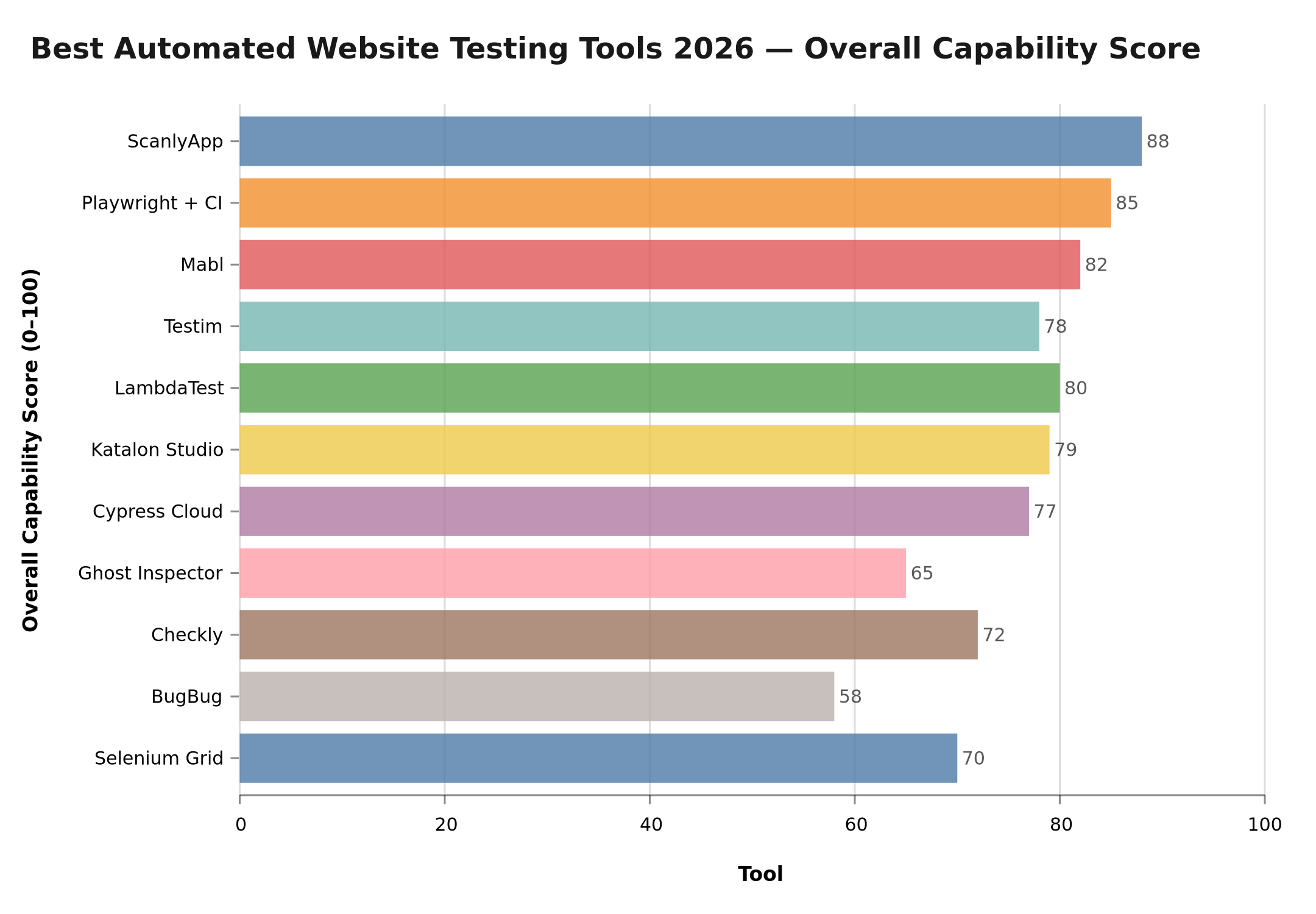 Figure: Overall capability scores (0–100) based on weighted evaluation across E2E coverage, feature depth, ecosystem maturity, CI/CD integration, and non-developer accessibility. Data: documented features + community reviews, March 2026.
Price vs. Capability Positioning
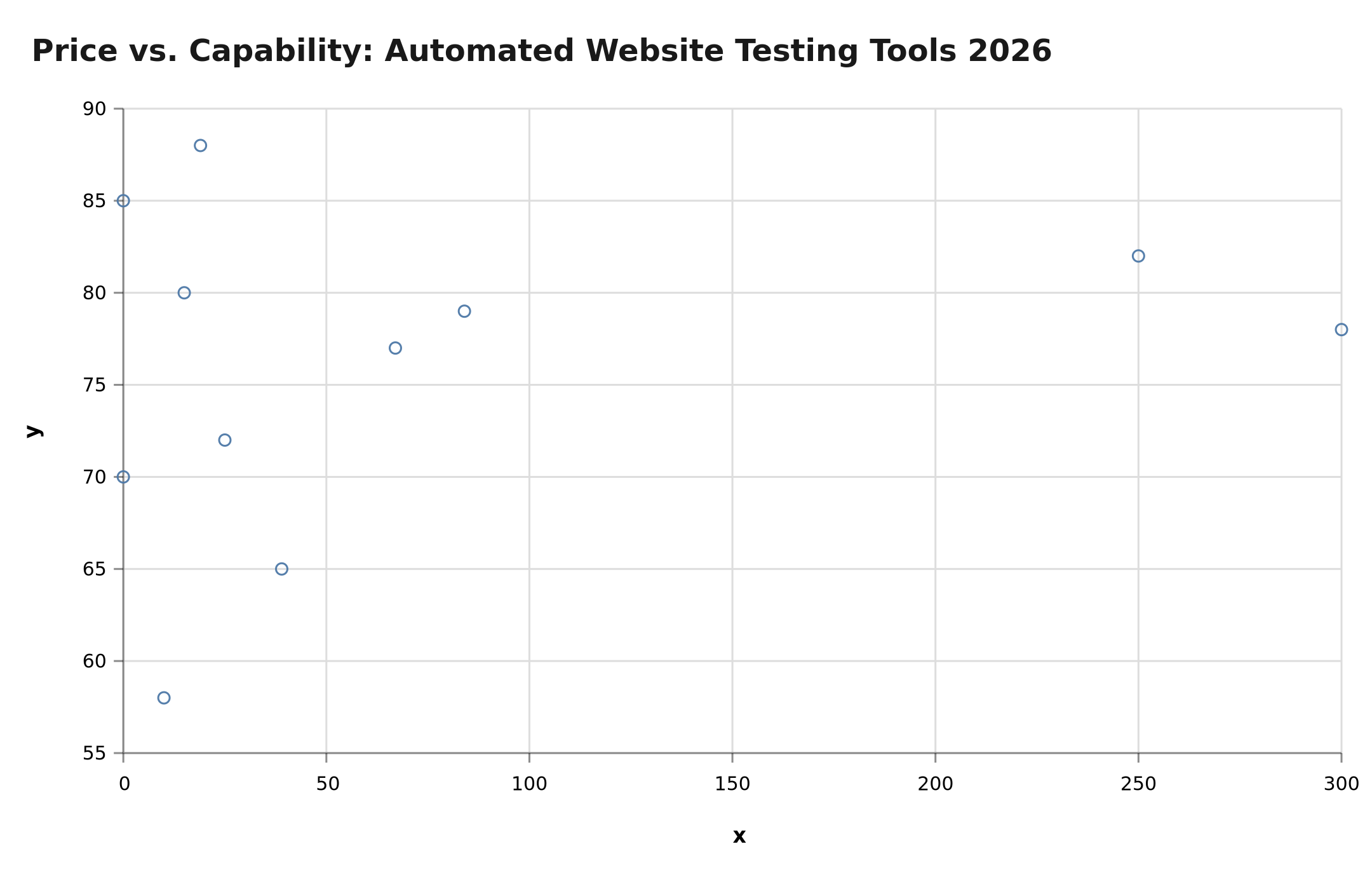 Figure: Each point represents one tool. X-axis: lowest monthly price (USD). Y-axis: overall capability score. Tools in the lower-left offer simplicity at low cost. ScanlyApp ($29, score 88) occupies the "high capability, accessible price" quadrant. Mabl and Testim (upper-right) offer enterprise capabilities at enterprise prices. March 2026.
The scatter plot makes the market structure clear:
- Free tier (x=0): Playwright and Selenium offer high capability at no direct cost, but require significant developer time and infrastructure to operate at scale.
- Best value zone ($10–$79): LambdaTest, ScanlyApp, BugBug, and Cypress Cloud deliver strong capability. ScanlyApp ($29, score 88) offers the best capability-per-dollar ratio in this cohort.
- Enterprise tier ($200–300+): Mabl and Testim offer marginal capability gains over ScanlyApp/LambdaTest for dramatically higher cost — the delta is only justified for dedicated enterprise QA programmes.
Buyer's Guide: Which Tool Is Right for Your Team?
By team type
Solo developer / freelancer Start with Playwright (free) for code-first tests and ScanlyApp's free plan for scheduled visual regression monitoring. Total cost: $0.
Small startup (3–10 engineers) ScanlyApp at $29/month covers E2E, visual regression, scheduling, and API testing with a dashboard your non-technical stakeholders can read. Pair with Playwright for complex user flows. No other tool at this price point matches this scope.
Mid-market product team (10–50 engineers) Consider LambdaTest for broad cross-browser and mobile device coverage, or Cypress Cloud if your frontend is heavily JS/TS component-driven. ScanlyApp remains relevant as the visual regression and monitoring layer even if you use a separate execution platform.
Enterprise / dedicated QA team (50+ engineers) Mabl or Katalon depending on scope (web-only vs. full-stack). Testim is viable if Salesforce UI testing is a major requirement. Budget for custom quotes and dedicated QA automation engineering time.
Agencies (multiple client projects) ScanlyApp's per-project pricing model is purpose-built for agencies: each client project is isolated, no seat tax as your team grows, and visual regression runs per-deploy so you catch client-site regressions before they do.
DevOps / monitoring-first teams Checkly's monitoring-as-code architecture (Playwright checks in git) is ideal. ScanlyApp provides a hybrid approach — monitoring-style scheduling with full QA-grade visual regression and reporting.
By use case
| Use case | Recommended tools |
|---|---|
| Catch visual regressions before deploy | ScanlyApp, Cypress Cloud, Mabl |
| Run smoke tests on a schedule | ScanlyApp, Checkly, Ghost Inspector |
| Cross-browser CI testing | Playwright, LambdaTest, ScanlyApp |
| No-code test authoring | BugBug, Ghost Inspector, Mabl |
| AI-assisted test maintenance | Testim, Mabl, LambdaTest (KaneAI) |
| Mobile device testing | LambdaTest, Katalon, Playwright |
| API + E2E in one tool | ScanlyApp, Katalon, Testim |
| Budget under $30/month | ScanlyApp ($29), LambdaTest ($15), BugBug (free) |
| Self-hosted / air-gapped | ScanlyApp (Docker), Selenium, Playwright |
How to Start Testing (Without Overthinking the Tool Choice)
One of the most common traps in automated testing is spending more time evaluating tools than writing tests. Here's a practical decision process:
1. Do you have zero automated tests today?
   → Start with ScanlyApp (free plan, no code required) and run your first
     visual regression scan in under 10 minutes.

2. Do you have Playwright tests but no cloud execution?
   → Connect them to ScanlyApp or LambdaTest this week.

3. Are you on a paid tool and spending more on maintenance than value?
   → Spend one sprint auditing: how many tests fail per week due to
     selector rot, not real bugs? If >20%, evaluate Playwright's
     built-in resilient locators before paying for ML self-healing.

4. Are you evaluating enterprise tools (Mabl, Testim)?
   → Pilot ScanlyApp for one month first. If it solves 80% of your
     problem at 10% of the cost, you have an answer.
Summary
The best automated website testing tool in 2026 depends on your constraints — but the pattern is consistent: most growth-stage teams are over-spending on enterprise tools or under-investing in free tools that require significant infrastructure work.
ScanlyApp occupies the gap: a real, Playwright-powered testing platform at a price any team can afford, with visual regression and scheduling out of the box, and a dashboard that doesn't require a QA automation engineer to interpret.
| Best overall (value + capability) | ScanlyApp |
|---|---|
| Best open-source framework | Playwright |
| Best for large organisations | Mabl or Katalon |
| Best for JS/TS frontend teams | Cypress Cloud |
| Best for monitoring-as-code | Checkly |
| Best free no-code option | BugBug |
| Best for mobile inclusion | LambdaTest |
Further Reading
- State of JS 2025: Testing frameworks
- Playwright official documentation
- G2: Best Automated Testing Software 2026
- Sematext: 14 Best Website Monitoring Tools in 2026
- TestGrid: Top Testing Tools Comparison 2026
Related articles:
- 7 Best Ghost Inspector Alternatives for Automated Web Testing in 2026
- 8 Best Checkly Alternatives for Synthetic Monitoring and Web QA in 2026
- 7 Best Testim Alternatives: AI-Powered Test Automation Without the Enterprise Price Tag
- 6 Best Mabl Alternatives: Powerful Web Testing Without the Enterprise Price Tag
- Playwright vs. Selenium vs. Cypress: The 2026 Showdown
Further Reading
- State of JS 2025 – Testing tools adoption
- Playwright documentation – Microsoft
- G2 Web Testing Software category
- Capterra Automated Testing Software comparison
Related articles: