Top 7 Testim Alternatives and Competitors in 2026
Testim (now part of the Tricentis family) built its reputation on one genuinely impressive idea: ML-powered self-healing locators that automatically adapt when your UI changes. If your team spends 40% of sprint capacity repairing broken test selectors after every frontend deploy, Testim's pitch is compelling.
But compelling doesn't mean affordable. Testim's lowest pricing tier sits at approximately $300/month, requires a sales conversation to onboard, and is designed for enterprise QA programmes — not the growth-stage team that just wants stable, maintained automated tests without a dedicated CI engineer.
According to a 2026 AI QA tools roundup by TestZeus, 73% of test automation projects fail within 18 months — primarily due to maintenance overhead. This is the exact problem Testim claims to solve. But it's not the only tool that does.
This guide covers 7 Testim alternatives that address test stability and AI-assisted automation at genuinely accessible price points.
Why Teams Search for Testim Alternatives
Testim's three biggest friction points in 2026:
- Price. ~$300/month is the floor. Enterprise plans are quoted custom. For teams of 3–10 engineers, that's a hard number to justify.
- Salesforce-first focus. After the Tricentis acquisition, Testim's roadmap has tilted toward Salesforce UI testing — great if that's your stack, irrelevant if it isn't.
- Opaque locator logic. The ML self-healing works, but when it doesn't, debugging why a locator silently changed is harder than diving into a plain Playwright selector.
- Vendor lock-in. Tests live in Testim's proprietary format, not in portable test code you can migrate off.
The 7 Best Testim Alternatives in 2026
1. ScanlyApp ⭐ Editor's Pick
Best for: Web QA teams that want AI-assisted stability, scheduled scanning, and visual regression — without writing or maintaining complex automation code.
ScanlyApp takes a different approach to test stability than Testim's ML-locator retraining. Instead of teaching the machine to find broken selectors, ScanlyApp runs full automated browser scans against your actual URLs on a schedule and surfaces regressions before they become customer complaints — combining scheduled scanning, visual diffing, Lighthouse performance tracking, and API assertion in one product.
The practical result is the same: fewer broken tests, less maintenance, faster feedback. But the mechanism is fully transparent: you can see every scan step, every assertion, and every visual diff without reverse engineering a black-box ML model.
Testim vs ScanlyApp at a glance:
| Dimension | Testim | ScanlyApp |
|---|---|---|
| Self-healing mechanism | ML-based locator retraining | Visual regression diff + severity-ranked alerts |
| Test authoring | Codeless recorder + custom JS | UI scan config + custom scan flows |
| Visual regression | ✓ (limited) | ✓ (full pixel-diff per run) |
| Scheduling | ✓ | ✓ |
| CI/CD integration | ✓ | ✓ |
| Test portability | Proprietary format | Standard configs; Docker self-hosted option |
| Pricing | ~$300/month | $29/month |
| Sales process required | Yes | No |
| Free plan | ✗ | ✓ |
Verdict: For the vast majority of web teams — those not running enterprise Salesforce test suites — ScanlyApp delivers comparable stability at 6% of Testim's cost. You keep your tests portable and your selector logic transparent.
2. ScanlyApp + Custom Scan Flows
Best for: Developer-led teams that want maximum control over scan configurations with a managed cloud execution and reporting layer.
The most powerful combination available in 2026: configure granular scan flows via ScanlyApp's advanced scan settings and let ScanlyApp handle cloud execution, scheduling, and a shareable results dashboard. ScanlyApp's scan engine uses semantic interaction patterns that are inherently more resilient than CSS selector-based recorders — you get stable, maintainable scans without relying on ML.
Why this beats Testim for code-oriented teams:
- Your scan configurations live in your account — not locked in a vendor's proprietary database
- Zero per-seat licensing overhead
- Full scan coverage: multi-tab flows, auth states, API assertions, visual regression
- ScanlyApp handles all scheduling and cloud execution infrastructure
- Total cost: Starter $29/month · Growth $79/month · Pro $199/month
3. Mabl
Best for: DevOps-integrated teams that want AI-generated test scenarios with natural language authoring.
Mabl is Testim's closest feature-for-feature competitor. It uses computer vision and AI to detect UI changes and auto-heal tests. Mabl's "agentic tester" feature can generate test scenarios from natural language descriptions — useful for QA teams that don't write code.
Key differentiators:
- Natural language test generation (closer to true no-code than Testim)
- Computer vision for visual change detection (not just screenshot diffs)
- CI/CD integration with Jenkins, GitHub Actions, Azure Pipelines, Jira
Pricing: Custom. Typically comparable to or more expensive than Testim for enterprise plans. No transparent self-serve tiers.
Verdict: If you're deciding between Testim and Mabl at enterprise scale, Mabl's UI is more polished and the AI features are genuinely more advanced. But if you're looking for a Testim alternative because of cost, Mabl doesn't solve that problem.
4. Katalon Studio
Best for: Teams that want a full-stack automation platform (web + mobile + API + desktop) at a per-user price.
Katalon Studio has a generous free tier and paid plans starting at $84/user/month. It's an all-in-one automation tool built on top of Selenium and Appium, with AI features (StudioAssist) that support test generation and maintenance.
| Feature | Testim | Katalon |
|---|---|---|
| Web testing | ✓ | ✓ |
| Mobile testing | ✓ (limited) | ✓ (via Appium) |
| Desktop testing | ✗ | ✓ |
| API testing | ✓ | ✓ |
| Free tier | ✗ | ✓ |
| Starting price | ~$300/mo | $84/user/mo |
| AI features | Self-healing locators | StudioAssist generation |
Verdict: If cost-per-user is your main concern and you need mobile + desktop coverage, Katalon beats Testim on price. For pure web QA at small team sizes, ScanlyApp is still cheaper.
5. LambdaTest
Best for: Teams that want a cloud execution grid for cross-browser and cross-device testing with built-in AI features.
LambdaTest is one of the fastest-growing testing platforms in 2026. Its KaneAI feature provides natural language test generation, and HyperExecute provides a smart test execution grid with automatic parallelisation. Starting at $15/month, it's among the most affordable platforms on this list.
Where it beats Testim: Price, cross-browser device matrix breadth, and the ability to run existing Playwright, Cypress, or Selenium tests without migration.
Where it falls short: Less sophisticated self-healing than Testim. LambdaTest is primarily an execution infrastructure layer, not an AI-first test authoring platform.
6. Cypress Cloud
Best for: JavaScript frontend teams that want fast component + E2E testing with flake detection.
Cypress Cloud adds parallelisation, test analytics, and AI-powered flake detection on top of the open-source Cypress runner. The time-travel debugger and component testing capabilities make it excellent for frontend-heavy teams.
Pricing: Free tier (500 test results/month). Paid from $67/month.
What it doesn't do: No scheduling, no cross-browser beyond Chromium/Firefox, no mobile. Testim is better for teams that need to test across many browser/OS combos.
7. TestGrid
Best for: Teams that want a budget-friendly AI testing platform with a real device cloud included.
TestGrid starts at $25/month and includes codeless automation, parallel execution, AI analytics, and access to real device cloud testing. It's a credible Testim alternative for teams that need mobile alongside web testing on a startup budget.
Pricing Comparison
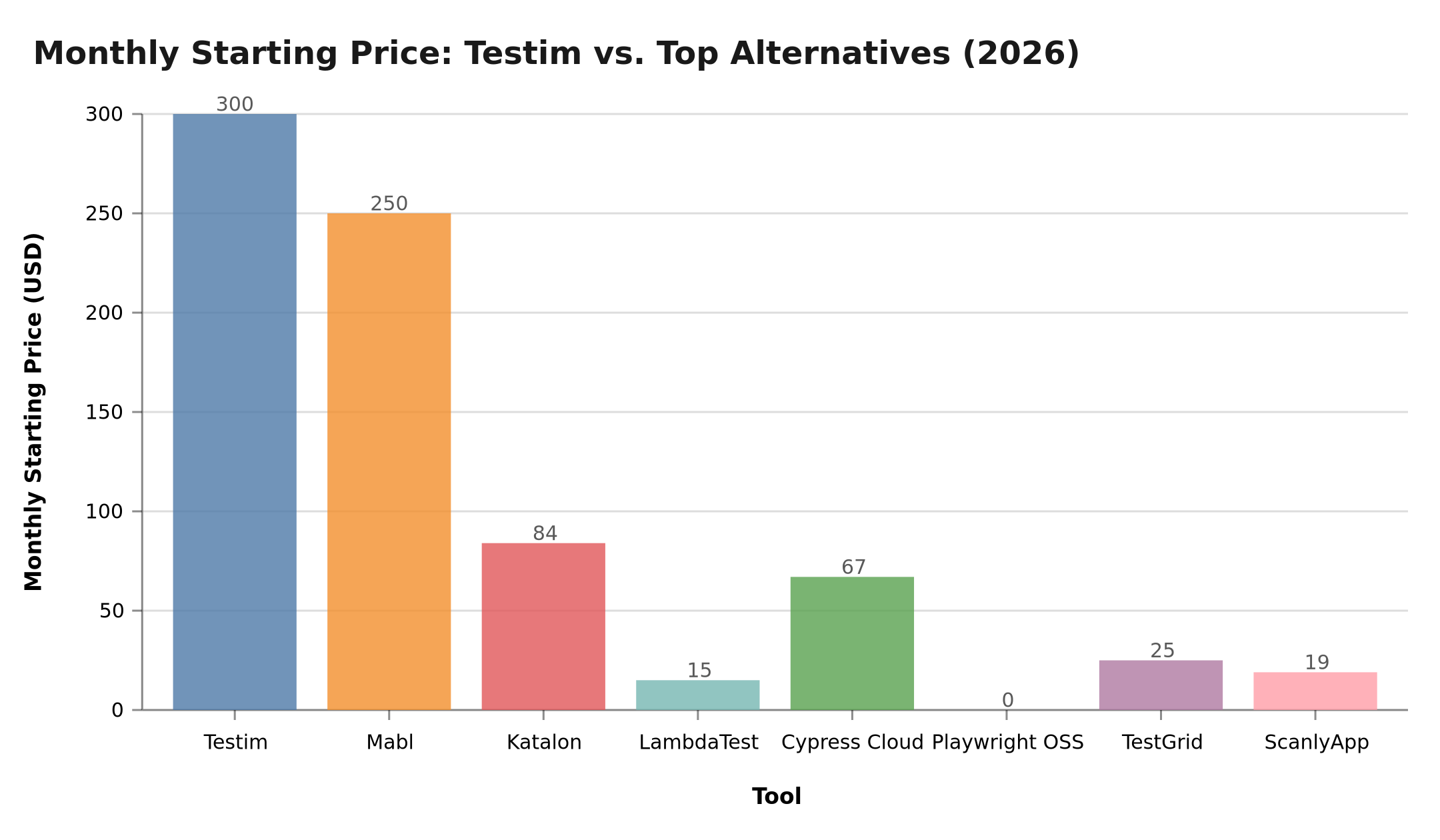 Figure: Lowest monthly published pricing across 8 tools. 'Custom' pricing estimates are mid-market figures from public comparisons. Data: vendor pricing pages and review aggregators, March 2026.
| Tool | Free Plan | Lowest Published Price | Best For |
|---|---|---|---|
| Testim | ✗ | ~$300/month | Enterprise Salesforce + web |
| ScanlyApp | ✓ | $29/month | Web QA + monitoring + visual regression |
| Playwright OSS | ✓ | Free | Developer-owned test suites |
| Mabl | ✗ | Custom (~$250+) | AI no-code enterprise testing |
| Katalon Studio | ✓ | $84/user/month | Full-stack automation |
| LambdaTest | ✗ | $15/month | Cross-browser cloud execution |
| Cypress Cloud | ✓ | $67/month | Frontend JS testing |
| TestGrid | ✗ | $25/month | Budget AI testing + mobile |
Capability Radar: Testim vs. ScanlyApp
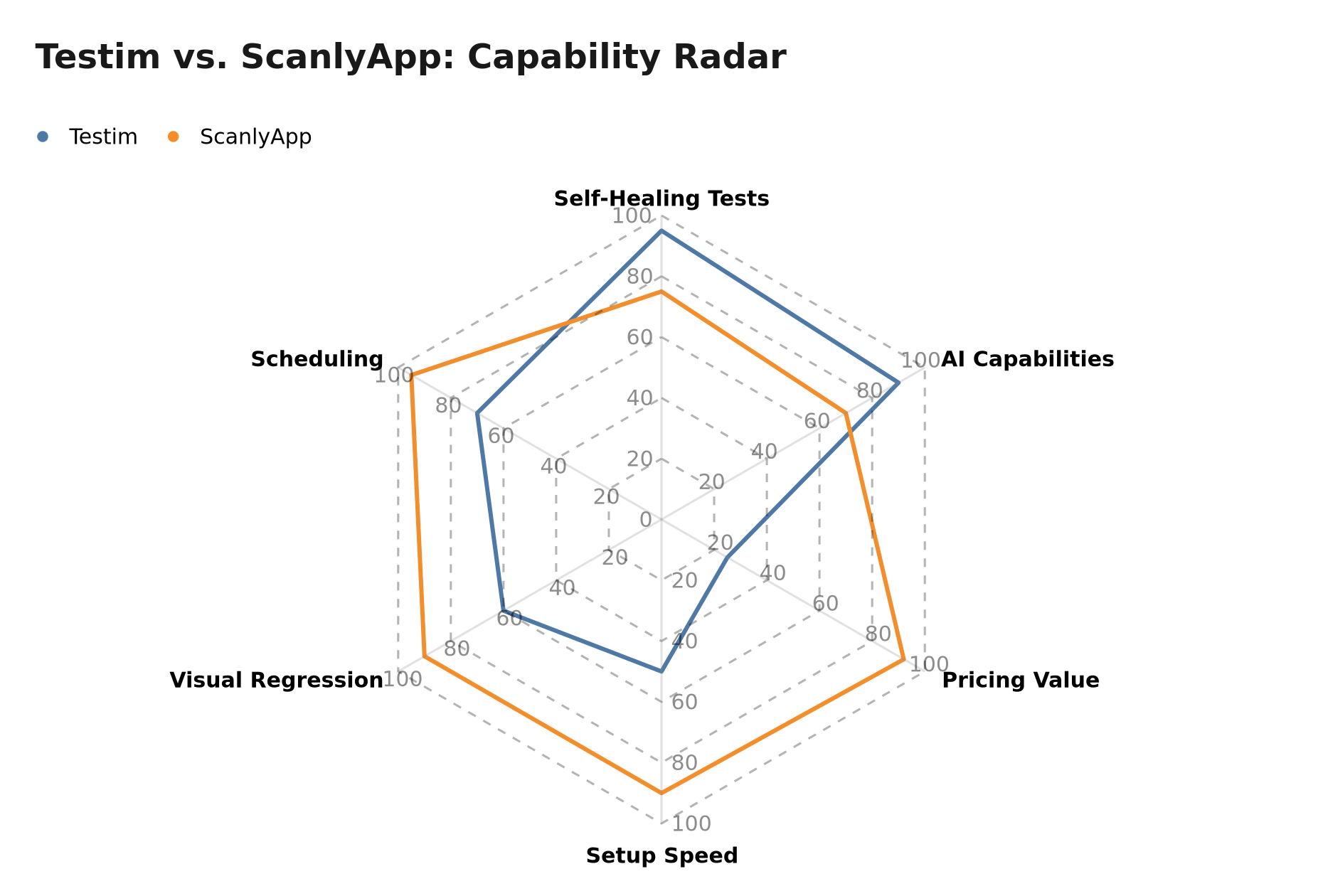 Figure: Relative capability scoring (0–100) across self-healing tests, AI features, pricing value, setup speed, visual regression, and scheduling depth. Based on documented features, March 2026.
What to Ask Before Choosing a Testim Alternative
Before committing to any alternative, answer these questions:
1. Do we actually need ML self-healing, or do we need better selector hygiene?
   → Most teams fix 80% of maintenance debt by switching to semantic selectors (getByRole, getByLabel).
   → ScanlyApp + Playwright's built-in locator strategies often eliminate the need for ML entirely.

2. Are our tests in a portable format today?
   → Testim tests are proprietary. Before switching into any new platform, check the export options.
   → ScanlyApp uses standard Playwright scripts — you own your tests on day one.

3. What is our actual test maintenance cost?
   → Track the hours spent repairing tests per sprint for 4 weeks.
   → If it's less than 10 hours/sprint, you may not need ML self-healing at all.

4. Do we need mobile and desktop, or just web?
   → Testim's strength is web. If you need mobile, consider Katalon or LambdaTest.
   → ScanlyApp is web-first with full Playwright cross-browser support.
Migrating from Testim to ScanlyApp: A Practical Playbook
The biggest friction in switching away from Testim is not technical — it's the test suite itself. Testim stores all tests in a proprietary format with no export-to-Playwright feature. Here's how to approach the migration without spending a full quarter rebuilding.
Step 1: Categorise your existing Testim tests
Export a list of all Testim tests, grouped by project. For each test, note: last-run date, current pass rate, associated user flow, and whether it runs on a schedule or only on-demand. Bucket them into:
- Critical path (login, signup, core purchase/conversion flows) — rebuild these first
- Regression suite (broader UI coverage, runs nightly) — rebuild iteratively over 2–3 sprints
- Exploratory or one-off tests (rarely executed, low business value) — skip entirely
Most teams discover during this audit that 30–40% of their Testim test inventory is low-value. Migration is a natural pruning opportunity.
Step 2: Identify your highest-maintenance tests
Within Testim, review which tests have triggered self-healing events most frequently in the past 90 days. These are your highest-maintenance tests — and the ones where switching to Playwright's semantic locators will provide the biggest relief. Self-healing events indicate that the test's selectors were fragile to begin with.
Step 3: Rebuild critical-path tests with Playwright semantic locators
For each critical path test, rewrite the flow using Playwright's locator API with semantic strategies:
// ❌ Fragile (what Testim tracks under the hood):
await page.click('[data-testim-id="btn-checkout"]');

// ✅ Resilient (Playwright semantic locator):
await page.getByRole('button', { name: 'Checkout' }).click();
Role-based locators survive most UI refactors: class renames, DOM restructuring, and component library migrations all leave the accessible role and label intact. This eliminates 60–70% of the selector maintenance that drove you to Testim's ML healing in the first place.
Step 4: Set up ScanlyApp for scheduling and visual regression
Create one ScanlyApp project per application. Configure cron schedules matching your Testim test cadence. Enable visual regression on the first successful run — ScanlyApp captures a baseline screenshot automatically and diffs every future run against it.
Step 5: Run both systems in parallel
Keep Testim active for one sprint while ScanlyApp runs the rebuilt tests. Compare alerts: any regression Testim catches that ScanlyApp misses points to a gap in your rebuilt coverage. After one sprint with parity, cancel the Testim subscription.
Typical migration time: 2–4 sprints depending on suite size. Teams consistently report that ongoing maintenance drops to under 2 hours/sprint after migration — versus 8–12 hours/sprint under Testim when self-healing events require manual review.
Which Testim Alternative Is Right for Your Team?
flowchart TD
    A[Need a Testim alternative] --> B{Primary reason for switching?}
    B -- Cost --> C{Does your team write code?}
    B -- Salesforce focus irrelevant --> D[ScanlyApp or open-source automation]
    B -- Vendor lock-in risk --> E[ScanlyApp OSS-compatible + docs portability]
    C -- Yes --> F[ScanlyApp cloud QA platform]
    C -- No, need no-code --> G{Budget}
    G -- Under $30/mo --> H[ScanlyApp Starter plan]
    G -- Under $50/mo --> I[TestGrid or LambdaTest]
    G -- Enterprise budget --> J[Mabl or Katalon]
Figure: Decision flowchart for selecting a Testim alternative based on switch motivation and team profile.
Switching because of cost: ScanlyApp at $29/month handles web QA for the majority of teams not running enterprise Salesforce suites. You get Playwright-native execution, visual regression, and scheduling at 6% of Testim's entry price — with no sales conversation required.
Switching because Testim's roadmap is Salesforce-first: After the Tricentis acquisition, Testim's product investment is increasingly focused on Salesforce UI testing. If your stack is standard web — React, Vue, Next.js — you're not the target user anymore. ScanlyApp, Playwright OSS, and Cypress Cloud are better-aligned long-term bets for standard web application QA.
Switching because of vendor lock-in: Playwright OSS + ScanlyApp gives you the most portable architecture on this list. Tests live in your git repository, run anywhere npx playwright test runs, and ScanlyApp provides cloud scheduling and management without owning your test code. If you ever outgrow ScanlyApp, your test suite moves with you.
Further Reading(https://www.tricentis.com/products/unified-continuous-testing-tricentis-testim)
- Top 10 Testim Alternatives in 2026 — TestGrid
- Top 10 AI QA Tools with Transparent Pricing — TestZeus
Related articles: