Top 7 Ghost Inspector Alternatives and Competitors in 2026
Ghost Inspector has been a go-to tool for no-code web test automation since 2014. It records browser interactions via a Chrome extension, replays them on a schedule, and alerts you when something breaks. For small teams with simple flows, it works well enough.
But teams scale, and Ghost Inspector's per-user pricing, Chromium-centric execution, and limited Playwright support start to chafe. Whether you're hitting the pricing ceiling, needing deeper CI/CD hooks, or wanting true cross-browser coverage backed by modern tooling, there are better options in 2026.
This guide covers 7 Ghost Inspector alternatives with real pricing data, honest trade-offs, and a clear recommendation for teams that want the best of automated scheduling, Playwright execution, and visual QA in one platform.
Why Teams Look for Ghost Inspector Alternatives
Ghost Inspector pioneered the "record a test in your browser, run it in the cloud" workflow. But several pain points are driving migration in 2026:
- Per-user seat pricing that scales poorly as teams grow
- No native Playwright support — Ghost Inspector runs Puppeteer under the hood, not Playwright
- Limited parallelism on lower tiers
- Fragile selectors — recorded CSS selectors break whenever the DOM changes
- No built-in visual regression diffing beyond basic screenshots
- Restricted API testing — HTTP-only, no deep auth flows or response assertions
According to a 2025 State of Test Automation report by Testgrid, 73% of test automation projects fail inside 18 months due to maintenance overhead — which maps directly to the brittle-selector problem Ghost Inspector users hit most often.
The 7 Best Ghost Inspector Alternatives
1. ScanlyApp ⭐ Editor's Pick
Best for: Development and QA teams that want automated cloud QA scanning with a zero-config dashboard.
ScanlyApp is a cloud-based automated QA platform that scans your web app on a schedule and surfaces regressions in a clean, shareable dashboard — no DevOps overhead required. Where Ghost Inspector records clicks and replays them, ScanlyApp runs deep multi-browser QA scans against your production or staging URLs on every schedule tick, generating an executive summary with severity breakdown and a visual diff for every run.
What makes ScanlyApp stand out:
- Executive summary + severity breakdown — every scan produces a prioritised report non-developers can act on
- Visual regression — screenshots compared across runs to catch layout shifts, colour changes, and missing elements
- Lighthouse performance tracking — performance scores tracked over time, with drop alerts on Growth+
- Shareable report links — send a live report URL to a client or PM without giving them platform access
- Multi-browser coverage — Chromium on Starter; add Firefox and WebKit on Pro
- Scheduling built-in — daily/weekly on Starter; cron + on-demand + CI-triggered on Growth and Pro
Key differentiators over Ghost Inspector:
| Feature | Ghost Inspector | ScanlyApp |
|---|---|---|
| Browser coverage | Chromium only | Multi-browser (Chromium + Firefox + WebKit·Pro) |
| Scheduling | Built-in cron | Cron + on-demand + CI-triggered |
| Visual regression | Screenshot diff (basic) | Full visual regression with per-run diffing |
| Executive summary | ✗ | ✓ severity breakdown on every run |
| Performance tracking | ✗ | ✓ Lighthouse scores + drop alerts |
| Shareable reports | ✗ | ✓ shareable link per run |
| API testing | HTTP checks only | ✓ full API + auth flow testing |
| CI/CD integration | Webhook trigger | ✓ native CI hooks + status badges |
| Self-hosted option | ✗ | ✓ via Docker |
Pricing: Starter $29/month · Growth $79/month · Pro $199/month. No per-seat charge — the whole team works from one subscription.
Verdict: If you're moving away from Ghost Inspector because you've outgrown its Chromium-only foundation, ScanlyApp is the most direct upgrade path: the same "set it and forget it" scheduling workflow, now with full multi-browser scanning, executive QA reports, and visual regression built in at every tier.
2. Playwright (Open Source)
Best for: Developer-led teams comfortable with JavaScript/TypeScript who want maximum control.
Microsoft Playwright is free and open source. It supports Chromium, Firefox, and WebKit, runs in CI natively, and has a best-in-class debugging experience with trace viewer and codegen. When you write Playwright tests, you own every selector, every assertion, every retry strategy — nothing is hidden behind a GUI.
Trade-offs vs Ghost Inspector:
| Dimension | Ghost Inspector | Playwright OSS |
|---|---|---|
| Setup time | 5 minutes (Chrome extension) | ~1 hour (project setup, CI wiring) |
| Code required | None | Yes (JavaScript/TypeScript/Python) |
| Cloud execution | Built-in | Self-hosted or via CI |
| Scheduling | Built-in | Via CI cron / external scheduler |
| Reporting | Built-in HTML dashboard | Custom (Allure, HTML reporter) |
| Cost | Paid SaaS | Free |
Verdict: The power ceiling is unlimited. The floor is steep — you need developers who'll maintain the suite. Pair Playwright OSS with ScanlyApp to get the scheduling, dashboard, and cloud execution layer on top.
3. Cypress Cloud
Best for: Frontend JavaScript teams who want fast component-level + E2E testing with excellent DX.
Cypress is the most popular JavaScript-first E2E framework. Cypress Cloud adds parallelisation, test analytics, and flake detection on top of the open-source runner. The DX is polished — time-travel debugging, real-time test runs in a browser, and an active ecosystem.
Limitations vs Ghost Inspector (for non-developers): Cypress requires JavaScript knowledge. There is no record-and-replay for non-technical users.
Pricing: Free tier (500 test results/month). Paid plans start at $67/month for 3 users.
4. BugBug
Best for: Non-technical QA teams who want a codeless alternative closest in feel to Ghost Inspector.
BugBug is probably Ghost Inspector's most direct feature-for-feature replacement. It offers the same Chrome extension recording workflow with a cleaner modern UI, unlimited test runs on its free plan, and a built-in email testing inbox.
BugBug vs Ghost Inspector at a glance:
| Feature | Ghost Inspector | BugBug |
|---|---|---|
| Browser support | Chrome, Firefox, Edge | Chromium only |
| Free plan | ✓ (limited) | ✓ (unlimited runs) |
| Custom JavaScript | ✓ | ✓ |
| Local test execution | ✓ via Docker/CLI | ✓ |
| Email testing | ✗ | ✓ (bugbug-inbox.com) |
| Pricing model | Per-user | Per-team |
Verdict: Excellent for teams that want the Ghost Inspector UX but with a more generous free tier. Codeless only — there's no escape hatch to code when your flows get complex.
5. Katalon Studio
Best for: Enterprises that need web, mobile, API, and desktop testing from a single tool.
Katalon Studio is an all-in-one test automation platform with a free edition and paid plans from $84/user/month. It supports both low-code recording and full Groovy/Java scripting, integrates with Jira / Azure DevOps / Jenkins, and covers web, mobile, API, and desktop in one tool.
Where it beats Ghost Inspector: Katalon's scripting flexibility and integration depth are in a different league for enterprise pipelines. Where it falls behind: the per-user pricing and steeper learning curve make it heavyweight for teams that just want "run these checks against my website every hour."
6. Testim (by Tricentis)
Best for: Enterprise teams that need AI self-healing selectors and Salesforce UI testing.
Testim uses machine learning to stabilise test selectors, significantly reducing maintenance when the UI changes. After being acquired by Tricentis, it's now positioned as an enterprise product. Pricing starts at approximately $300/month — a steep jump from Ghost Inspector.
Key capability: Self-healing locators that automatically adapt to DOM changes without manual test updates. This directly solves Ghost Inspector's biggest pain point (broken selectors after UI deploys).
Trade-off: Complex pricing, no transparent tiers, and the enterprise sales motion means slow onboarding for small teams.
7. Microsoft Playwright Testing (Azure)
Best for: Teams already in the Azure ecosystem who want cloud-hosted Playwright execution at scale.
Microsoft Playwright Testing is Azure's managed service for running Playwright tests on cloud browsers. It integrates with GitHub Actions, Azure Pipelines, and any CI that can run npx playwright test. Pricing is usage-based (~$0.05 per test minute).
Where it fits: If you've already got Playwright tests and just need managed cloud execution with global regions, this is a clean upgrade from Ghost Inspector's cloud runner. You bring the tests; Azure brings the scale.
Pricing Comparison
 Figure: Monthly starting price (lowest paid tier) across 7 tools. Free tiers shown as $0. Data: vendor pricing pages, March 2026.
| Tool | Free Plan | Starting Price | Pricing Model |
|---|---|---|---|
| Ghost Inspector | ✓ (100 runs/mo) | ~$25/month | Per-user seats |
| ScanlyApp | ✓ | $29/month | Per-project |
| Playwright OSS | ✓ | Free | Open source |
| Cypress Cloud | ✓ (500 results/mo) | $67/month | Per-user |
| BugBug | ✓ (unlimited runs) | $15/month | Per-team |
| Katalon Studio | ✓ (limited) | $84/user/month | Per-user |
| Testim | ✗ | ~$300/month | Custom enterprise |
| MS Playwright Testing | ✗ | ~$0.05/test-min | Usage-based |
Feature Depth Comparison
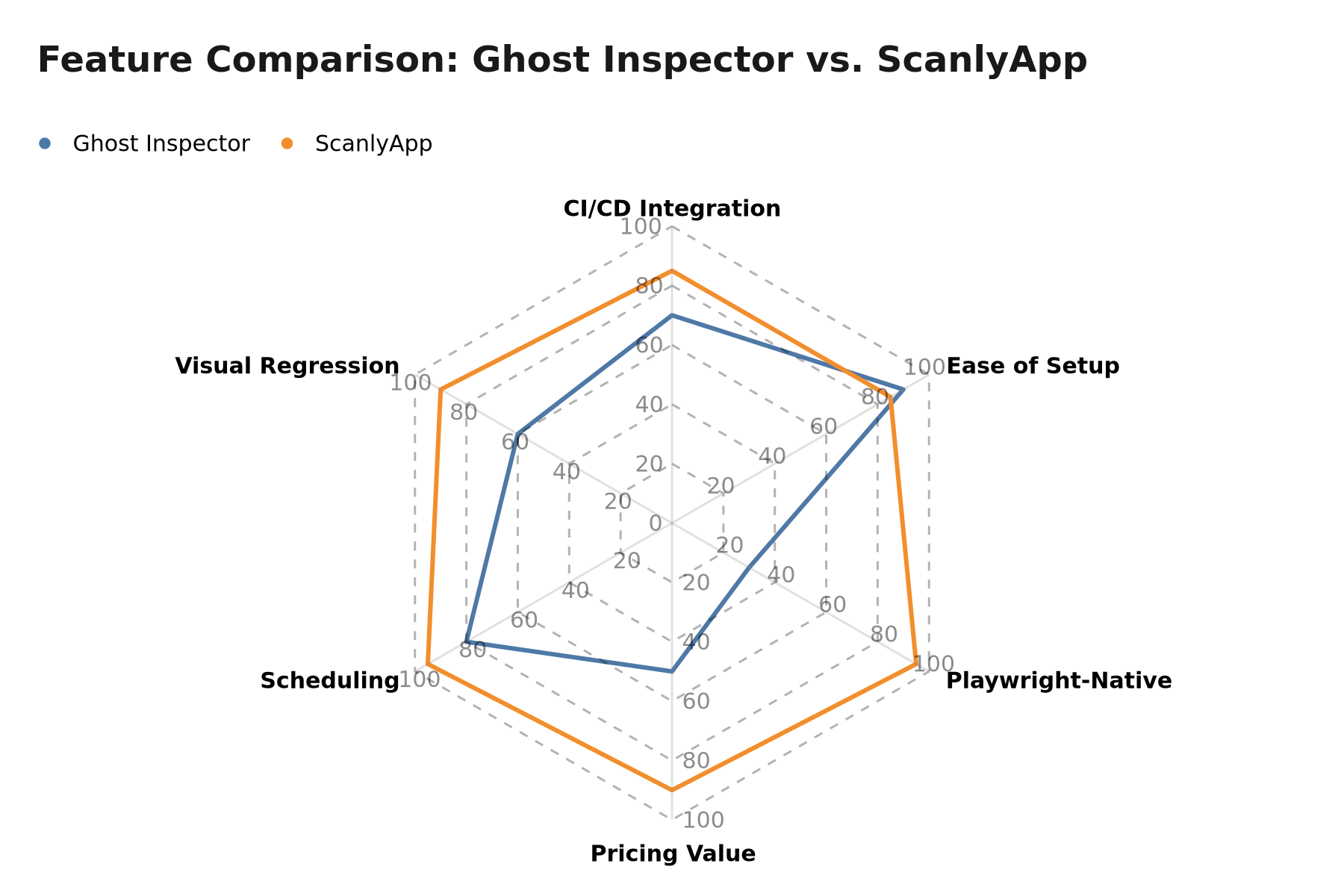 Figure: Feature scoring (0–100) across CI/CD integration, setup ease, Playwright-native execution, pricing value, scheduling depth, and visual regression. Based on documented feature sets, March 2026.
flowchart TD
    A[Start: Web Testing Need] --> B{Require no-code?}
    B -- Yes --> C{Budget?}
    B -- No --> D{Playwright expertise?}
    C -- Under $20/mo --> E[ScanlyApp]
    C -- Free only --> F[BugBug Free]
    C -- Enterprise budget --> G[Katalon or Testim]
    D -- Yes --> H{Need cloud scheduling?}
    D -- No --> I[Learn Playwright - free]
    H -- Yes --> E
    H -- No --> J[Playwright OSS + CI]
Figure: Decision tree for selecting a Ghost Inspector alternative based on team needs and budget.
How to Migrate from Ghost Inspector to ScanlyApp
If you've decided ScanlyApp is the right move, migration is straightforward:
- Export your Ghost Inspector test IDs — note which URLs and user flows each test covers
- Re-express the flows as Playwright scripts — ScanlyApp provides starter templates for common patterns (login, form submission, checkout)
- Set up your first project in ScanlyApp and connect your URL
- Configure your schedule — ScanlyApp uses the same cron-style scheduling as Ghost Inspector
- Enable visual regression — turn on pixel-diff comparison on the project settings page
- Run parallel for 2 weeks before decommissioning Ghost Inspector — compare alerts from both tools to validate coverage
The typical migration takes one sprint. You end up with Playwright-backed tests that are more resilient than Ghost Inspector's recorded selectors and a dashboard that surfaces regressions faster.
Why Puppeteer vs. Playwright Matters for Long-Term Tests
Ghost Inspector's Puppeteer foundation is not just a technical footnote — it's a maintenance commitment that compounds over years of use.
Browser coverage gap. Puppeteer supports Chromium only (with experimental, partially-supported Firefox). Playwright supports Chromium, Firefox, and WebKit (the Safari engine used by every iOS browser) as fully maintained, stable targets. If Safari bugs are affecting your users — and for consumer-facing web products on iOS they routinely do — Ghost Inspector cannot catch them. You need a second tool, which means a second subscription, second suite of tests, and double the maintenance burden.
Selector stability. Ghost Inspector's Chrome extension recorder generates CSS selectors that map to the DOM structure at the moment of recording. A typical output looks like .page-wrapper > form > div:nth-child(3) > button. This selector breaks the moment a developer wraps the form in another div, renames a class, or refactors the component hierarchy. Playwright's locator API is built around semantic attributes: getByRole('button', { name: 'Submit' }) finds the element by its accessible role and label — surviving every refactor that doesn't change the element's functional meaning. This is the single biggest predictor of long-term test resilience.
Ecosystem trajectory. Playwright surpassed 70,000 GitHub stars in 2026 and is backed by Microsoft's developer tools division. It underpins every major new testing product launched since 2022. Puppeteer's development pace is slower, its community smaller, and its integration with modern test tooling (Allure, Playwright Test runner, ScanlyApp) is limited. Building a test suite on Puppeteer today means maintaining against a diminishing ecosystem.
What this means in practice: Ghost Inspector users consistently report that tests require intervention after major frontend deploys — not because the functionality broke, but because the Puppeteer-recorded selectors no longer match the refactored DOM. Switching to a Playwright-native platform like ScanlyApp reduces that selector-break rate significantly because the locator strategies decouple from DOM structure.
Common Questions When Switching from Ghost Inspector
Q: Can I import my Ghost Inspector tests directly into ScanlyApp? Not as automated imports — Ghost Inspector's test steps (JSON-based action sequences) don't translate 1:1 to Playwright scripts. The migration path is to use your Ghost Inspector test list as a spec sheet and rewrite each test as a ScanlyApp scan or Playwright script. Most teams find this process reveals which tests were providing real value and prune 30–40% of redundant coverage in the process.
Q: Will ScanlyApp fire a visual regression alert on every run? Yes. ScanlyApp captures a baseline screenshot on the first successful run and diffs every subsequent run against it pixel-by-pixel. You configure the sensitivity threshold (e.g., ignore differences under 1% of pixels), and approve or reject diffs from the dashboard. Intentional UI changes are handled by updating the baseline with one click.
Q: How long does migration from Ghost Inspector take? For a team with 20–30 Ghost Inspector tests, migration to ScanlyApp typically takes 3–5 days of engineering time spread across one sprint. Most of that time is the Playwright script rewrite — ScanlyApp configuration itself takes under an hour.
Q: Can we run Ghost Inspector and ScanlyApp simultaneously during the transition? Yes, and this is the recommended approach. Run both tools against the same URLs for two weeks post-migration. When ScanlyApp's detection rate matches Ghost Inspector's, and you've validated coverage depth, decommission Ghost Inspector.
Q: Does ScanlyApp have a free plan for evaluating the switch? Yes. ScanlyApp offers a free trial with no credit card required. You can connect your production URL, run real automated QA scans, and view visual regression results before deciding whether to commit to the $29/month Starter plan.
Verdict
Ghost Inspector was the right tool for 2018. In 2026, the best Ghost Inspector alternative depends on your team's technical depth:
- Non-technical / small team → ScanlyApp (best full-feature-to-price ratio) or BugBug (free tier)
- Developer-led team → Playwright OSS + ScanlyApp for scheduling and execution layer
- Frontend-focused team → Cypress Cloud
- Enterprise / Salesforce → Testim or Katalon
ScanlyApp hits the sweet spot for the majority of growth-stage web teams: Playwright-native execution, built-in scheduling, visual regression, and no per-seat pricing — all at a fraction of what Ghost Inspector charges for comparable capability.
Further Reading
- Playwright official documentation
- Ghost Inspector vs Katalon on G2
- 2025 State of Test Automation – Testgrid
Related articles: