Top 8 WebdriverIO Alternatives and Competitors in 2026
WebdriverIO is a well-maintained, production-grade test automation framework built on top of the WebDriver protocol. It supports cross-browser testing, mobile automation via Appium, rich reporting plugins, and a service-based integration architecture that lets teams compose their own test infrastructure. For JavaScript and TypeScript teams with existing WebDriver infrastructure, WebdriverIO is a solid choice.
But WebdriverIO has real limitations that push teams to look elsewhere: WebDriver protocol overhead makes tests 2–3x slower than CDP-based alternatives; configuration depth creates steep setup curves for newcomers; and the ecosystem is smaller than Playwright's growing momentum. This guide evaluates 8 WebdriverIO alternatives in April 2026.
Why Teams Look for WebdriverIO Alternatives
- Speed. WebDriver works via an external driver process that mediates all interactions. Playwright communicates directly via Chrome DevTools Protocol (CDP) and WebSockets — tests run measurably faster.
- Configuration complexity. WebdriverIO's flexibility comes with a large configuration surface. Getting the
wdio.conf.jsright for your specific CI environment, browser versions, and reporting plugins is non-trivial. - Community momentum. Playwright's community has grown faster since 2023. Stack Overflow answer coverage, GitHub issue resolution speed, and ecosystem plugin quality increasingly favour Playwright.
- Multi-language. WebdriverIO is JavaScript/TypeScript only. Teams with Python, Java, or C# test infrastructure cannot adopt WebdriverIO without a rewrite.
- No managed execution layer. WebdriverIO is purely a framework — teams must build or buy their own scheduled execution, visual regression, and CI reporting layer.
The 8 Best WebdriverIO Alternatives in 2026
1. Playwright ⭐ Best Framework Alternative
Best for: Teams that want maximum performance and capability from an open-source framework.
Playwright, backed by Microsoft, is the highest-growth end-to-end test framework in 2025–2026. For WebdriverIO users, the migration appeal is clear:
- 2–3x faster tests due to CDP/WebSocket-based browser communication vs WebDriver protocol overhead
- Native multi-browser (Chromium, Firefox, WebKit) without Selenium Grid infrastructure
- Multi-language (JavaScript, TypeScript, Python, Java, C#) — no rewrite required if your backend tests are in Python or Java
- Built-in parallelism — Playwright runs tests in parallel by default without an external grid
- First-class debugging tools — trace viewer with DOM timeline, screenshots, videos, and network log on every failing test
Pricing: Completely free and open source.
Head-to-head: WebdriverIO vs Playwright
| Feature | WebdriverIO | Playwright |
|---|---|---|
| Protocol | WebDriver (slower) | CDP + WebSockets (faster) |
| Languages | JS / TypeScript | JS, TS, Python, Java, C# |
| Browsers | All major browsers | Chromium, Firefox, WebKit |
| Mobile testing | ✓ Appium integration | Limited (experimental) |
| Parallel execution | Via Selenium Grid | ✓ native |
| Debugging tools | Allure reports, plugins | ✓ trace viewer, DOM snapshots |
| Setup complexity | High | Medium |
| Community growth | Stable | High (fastest growing 2025-26) |
2. ScanlyApp ⭐ Editor's Pick (Managed Execution Layer)
Best for: WebdriverIO users who want to shift test execution to a managed cloud without rewriting their test infrastructure.
WebdriverIO is a framework — it doesn't provide scheduling, visual regression, cloud execution management, or a non-developer dashboard. Teams that outgrow running wdio locally in CI often look for a managed platform to run their automated tests on a schedule, compare screenshots, and give QA managers visibility without a terminal.
ScanlyApp is that managed layer. Teams migrating off WebdriverIO can connect to ScanlyApp and immediately benefit from cloud execution scheduling, visual regression diffs, Lighthouse performance tracking, CI triggering, and an executive summary dashboard.
What ScanlyApp adds beyond WebdriverIO alone:
| Capability | WebdriverIO alone | ScanlyApp |
|---|---|---|
| Scheduled cron execution | ✗ | ✓ |
| Visual regression (pixel-diff) | ✗ (plugin required) | ✓ built-in per run |
| CI-triggered test runs | Via shell script | ✓ native Webhook + GitHub Actions |
| Non-dev project dashboard | ✗ | ✓ |
| Centralised test history | ✗ | ✓ per project |
| Docker self-host | ✗ | ✓ |
| API test monitoring | Plugin required | ✓ built-in |
| Free plan | n/a (open source) | ✓ |
| Managed execution cost | Your CI cost | $29/month |
Pricing: Starts at $29/month (Starter). Growth $79/month, Pro $199/month. No per-seat pricing.
3. Cypress
Best for: Frontend-focused JavaScript/TypeScript developers who want excellent developer experience for UI testing.
Cypress offers time-travel debugging, real-time command execution, automatic waiting, and a clean test runner interface that makes local development feedback loops fast. For teams writing frontend tests day-to-day, Cypress's developer experience is class-leading.
Pricing: Free (framework). Cypress Cloud from $75/month.
Where it beats WebdriverIO: The developer experience floor is higher — Cypress tests are faster to write, easier to debug locally, and require less configuration for a standard web app.
Limitation: JavaScript/TypeScript only. Cypress Cloud pricing adds up quickly for teams with multiple parallel pipelines.
4. TestCafe
Best for: Teams that want quick setup with no WebDriver, no browser plugins, and no complex configuration.
TestCafe runs tests entirely within Node.js — no external WebDriver binary, no browser plugin, no certificate setup. It injects a proxy into the test page and communicates with the browser directly. This architectural simplicity makes TestCafe the fastest framework to get up and running, particularly for teams new to end-to-end testing.
Pricing: Completely free and open source. TestCafe Studio (GUI) is commercial.
5. Nightwatch.js
Best for: Node.js teams that want a WebDriver-based framework with good BrowserStack/Sauce Labs integration maintained by the cloud testing ecosystem.
Nightwatch.js is maintained by BrowserStack, which means its integration with BrowserStack's real device cloud is first-class. It uses WebDriver protocol (like WebdriverIO) but provides a cleaner, more opinionated configuration and a built-in test runner. Teams coming from WebdriverIO often find Nightwatch a more streamlined WebDriver alternative if they want to keep the WebDriver protocol.
Pricing: Completely free and open source.
6. Puppeteer
Best for: Teams that exclusively test Chromium-based applications and need maximum Chrome automation speed.
Puppeteer is Google's Node.js library for Chrome and Chromium automation via CDP. It's the fastest Chromium-specific automation tool available — because it only targets one browser, the implementation is deeply optimised. Teams doing screenshot capture, PDF generation, or high-throughput Chrome scraping will find Puppeteer faster than Playwright or WebdriverIO for Chromium-only work.
Pricing: Completely free and open source.
Limitation: Chrome/Chromium only. For cross-browser testing, Playwright is the natural path forward.
7. Katalon Studio
Best for: Mixed teams where QA analysts without deep programming experience need to contribute to test automation alongside developers.
Katalon Studio wraps Selenium and Appium with a higher-level UI, record-and-playback test creation, and keyword-driven scripting. Teams with QA analysts who can write keywords but not TypeScript benefit from Katalon's lower entry barrier. Developers can still write script-level tests when needed.
Pricing: Free tier for individual users. Team from $208/user/month.
8. TestSprite
Best for: Teams that want AI-autonomous test generation and execution without maintaining test code.
TestSprite is an AI-powered test automation platform that generates tests by crawling your application, executes them in parallel in the cloud, and automatically updates tests when the UI changes. Early adopters report pass rate improvements from 42% to 93% through AI-driven test healing.
Pricing: Contact for pricing.
Pricing Comparison
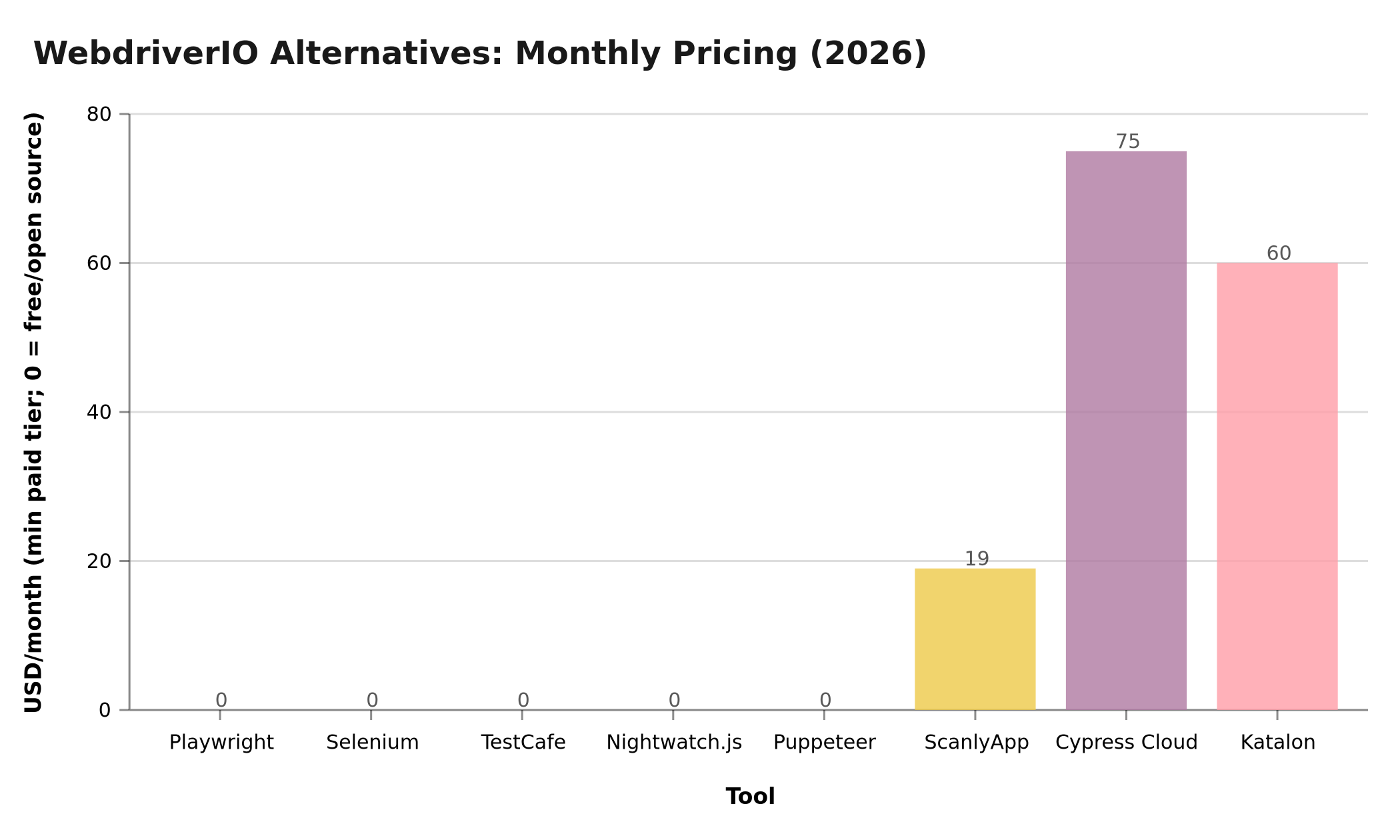 Figure: Starting monthly cost for a 3–5 person team. Open-source tools show infrastructure cost as zero; managed platforms show lowest paid tier. Data: vendor pricing pages, April 2026.
| Tool | Free Plan | Entry Paid Cost | Language Support | Parallel Execution |
|---|---|---|---|---|
| WebdriverIO | ✓ (open source) | $0 | JS / TypeScript | Via Selenium Grid |
| Playwright | ✓ (open source) | $0 | JS, TS, Python, Java, C# | ✓ native |
| ScanlyApp | ✓ | $29/month | Playwright-native (TS) | ✓ managed |
| Cypress | ✓ (limited) | $75/month (Cloud) | JS / TypeScript | Cloud-only |
| TestCafe | ✓ (open source) | $0 (StudioPro paid) | JS / TypeScript | ✓ built-in |
| Nightwatch.js | ✓ (open source) | $0 | JS / TypeScript | ✓ built-in |
| Puppeteer | ✓ (open source) | $0 | JS / TypeScript | Manual |
| Katalon | ✓ | $208/user/month | Java / Groovy / Script | ✓ cloud |
Feature Radar: WebdriverIO vs ScanlyApp
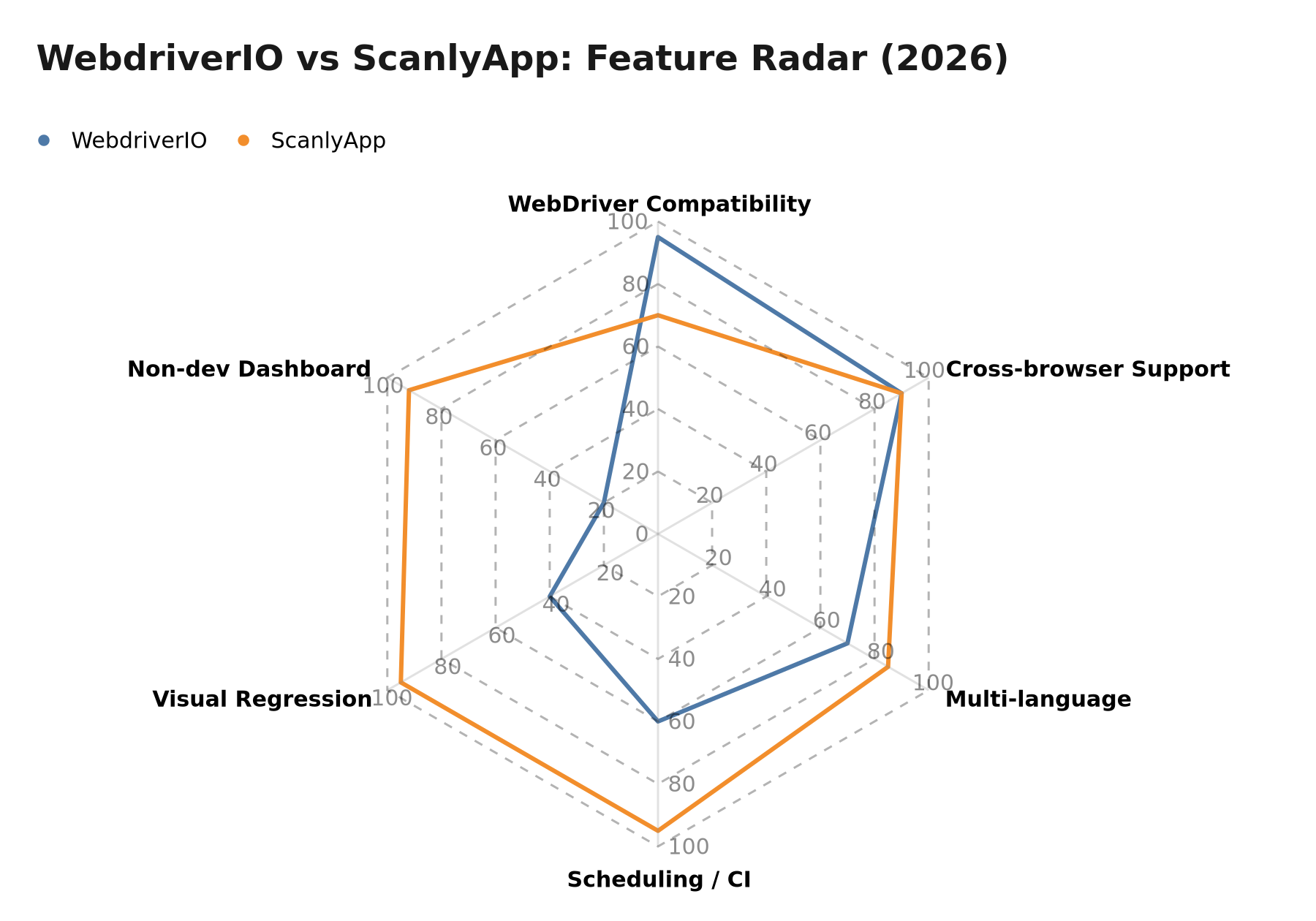 Figure: Feature scores (0–100) comparing WebdriverIO and ScanlyApp across Framework Flexibility, Visual Regression, Scheduling, Pricing Value, Setup Simplicity, and Non-Dev Dashboard. April 2026.
Migration Path: WebdriverIO to Playwright + ScanlyApp
flowchart LR
    A[WebdriverIO tests in CI] --> B{Migration scope}
    B -- Rewrite tests in Playwright --> C[Playwright framework]
    B -- Keep existing JS tests, add managed layer --> D[ScanlyApp wraps existing scripts]
    C --> E[Connect to ScanlyApp for managed execution]
    D --> E
    E --> F[Scheduled + visual regression + dashboard]
WebdriverIO API patterns translate naturally to Playwright. The core concepts — page objects, selectors, assertions, hooks — carry over. A typical WebdriverIO test can be migrated to Playwright in 30–60 minutes per test file.
Which WebdriverIO Alternative Is Right for You?
flowchart TD
    A[WebdriverIO alternative] --> B{What's your main friction point?}
    B -- Test speed is too slow --> C[Playwright]
    B -- Setup complexity --> D[TestCafe or Cypress]
    B -- Need managed scheduling and visual regression --> E[ScanlyApp]
    B -- Non-dev team needs to contribute --> F[Katalon or Testsigma]
    B -- Chrome only focused work --> G[Puppeteer]
    B -- Keep WebDriver protocol with BrowserStack --> H[Nightwatch.js]
    C --> I{Also need cloud execution?}
    I -- Yes --> E
    I -- Self-hosted CI is fine --> C
Further Reading
Related articles: