Top 8 Cypress Alternatives and Competitors in 2026
Cypress transformed frontend testing when it launched. Time-travel debugging, real-time command execution, automatic waiting — the developer experience was a full generation ahead of Selenium-era frameworks. Today, Cypress remains popular, but teams are increasingly looking for alternatives because of language lock-in (JavaScript/TypeScript only), Cypress Cloud pricing ($75/month to $250+/month), and slower cross-browser support compared to Playwright.
This guide evaluates 8 Cypress alternatives available in April 2026 — from open-source frameworks for teams that write their own tests to managed execution platforms for teams that want someone else to run them.
Why Teams Move Away from Cypress
Cypress's growth has been accompanied by a narrowing niche:
- Language lock-in. Cypress is JavaScript/TypeScript only. Teams with Python, Java, or C# test suites cannot use Cypress without rewriting existing test code.
- Cypress Cloud pricing. The free Cloud tier supports 3 users and limited parallel runs. The Starter plan is $75/month (5 users, 25 parallel runs). Team is $250+/month. For mid-sized engineering orgs, Cypress Cloud adds up to $15,000–$40,000/year.
- Slow cross-browser story. Cypress added Firefox and WebKit support, but Playwright's native WebKit engine provides more complete Safari-parity coverage.
- Limited multi-origin/multi-tab. Automatic domain restriction has only recently been lifted. Tests requiring multi-domain navigation or multiple tabs still require workarounds.
The 8 Best Cypress Alternatives in 2026
1. Playwright ⭐ Best Open-Source Alternative
Best for: Teams that want maximum framework capability with zero licensing cost.
Playwright is Microsoft-backed and has become the default choice for new greenfield test suites in 2025–2026. The core advantages over Cypress are broad: multi-language support (JavaScript, TypeScript, Python, Java, C#), true cross-browser testing (Chromium, Firefox, WebKit), native parallel execution without a cloud service, multi-page/multi-domain testing, and a comprehensive tracing/debugging story (screenshots, videos, DOM snapshots on failure).
Pricing: Completely free and open source. No Cloud service required for parallel execution.
G2 rating: 4.7/5.
Head-to-head: Cypress vs Playwright
| Feature | Cypress | Playwright |
|---|---|---|
| Languages | JS / TypeScript only | JS, TS, Python, Java, C# |
| Browsers | Chromium, Firefox, WebKit | Chromium, Firefox, WebKit |
| Parallel execution | Requires Cypress Cloud | Native (no Cloud) |
| Multi-origin tests | Workarounds required | ✓ native |
| Multi-tab tests | Limited | ✓ native |
| Screenshots/video | ✓ with Cloud | ✓ built-in |
| Trace viewer | Partial | ✓ full DOM timeline |
| Licensing | Free (Cloud paid) | Free, open-source |
| CI integration | ✓ | ✓ |
Verdict: For teams building a new test suite or migrating from Cypress, Playwright is the recommendation in virtually every post-2025 evaluation.
2. ScanlyApp ⭐ Editor's Pick (Managed Cloud QA Platform)
Best for: Teams that want a managed cloud QA execution layer — replacing Cypress Cloud at 1/4 the cost.
Many teams switch from Cypress to more advanced frameworks for writing tests, but then hit the same problem: they need a managed execution platform for scheduling, CI integration, reporting, and visual regression. That's where Cypress Cloud was useful. ScanlyApp provides exactly that platform — an advanced cloud QA scanner with executive summaries, severity-ranked issue reports, and visual regression diffs.
What ScanlyApp replaces in this scenario:
- Cypress Cloud's test scheduling → ScanlyApp's cron scheduling + on-demand runs
- Cypress Cloud's parallel execution → ScanlyApp's managed cloud runner
- Cypress Cloud's test recording/video → ScanlyApp's screenshot + visual regression diff per run
- Cypress Cloud's team dashboard → ScanlyApp's project dashboard (shareable with QA managers, not just developers)
Cypress Cloud vs ScanlyApp
| Feature | Cypress Cloud (Starter) | ScanlyApp |
|---|---|---|
| Playwright native | ✗ | ✓ |
| Cypress support | ✓ | ✗ |
| Visual regression | ✗ | ✓ pixel-diff per run |
| Scheduling | CI trigger only | ✓ cron + on-demand + CI |
| Non-dev dashboard | Limited | ✓ standalone |
| Browser coverage | Chrome/Firefox/WebKit | Multi-browser (Chromium + Firefox + WebKit·Pro) |
| Self-hosted | ✗ | ✓ Docker |
| Free plan | ✓ (3 users, limited) | ✓ |
| Pricing | $75/month (Starter) | $29/month |
Pricing: Starts at $29/month (Starter). Growth $79/month, Pro $199/month.
3. WebdriverIO
Best for: Teams that prefer the WebDriver protocol and need the most flexible integration surface with existing Selenium infrastructure.
WebdriverIO is a Node.js-based test automation framework using WebDriver protocol. It supports Chrome, Firefox, Safari, and Edge, integrates with any CI system, and provides a rich plugin ecosystem. Teams already using Selenium Grid or Appium benefit from WebdriverIO's ability to reuse that infrastructure.
Pricing: Completely free and open source.
Setup time: 10–15 minutes for a basic suite.
Where it falls short vs Playwright: WebDriver protocol adds latency compared to Playwright's CDP-direct and WebSockets approach — WebdriverIO tests typically run 2–3x slower than equivalent Playwright tests.
4. Selenium + Selenium Grid
Best for: Multi-language teams (Java, Python, C#, Ruby) and organisations with existing Selenium investment.
Selenium is the original browser automation framework and still the most broadly supported. Java shops in particular tend to stay with Selenium because the ecosystem of Java testing libraries, CI integrations, and internal knowledge is already built around it.
Pricing: Completely free and open source.
Where it falls short: Selenium's architecture is WebDriver-protocol-based, making it noticeably slower than Playwright for high-volume test runs. No built-in scheduling, visual regression, or modern debugging tooling.
5. Testsigma
Best for: QA teams without deep coding expertise who need to write and maintain browser tests using natural language.
Testsigma is an AI-powered test automation platform that allows tests to be written in plain English, then executed across browsers and real devices. The AI layer handles test maintenance (auto-healing when page elements change) and test generation from application usage patterns.
Pricing: Freemium. Paid plans from $499/month (full feature set).
Setup time: Under 5 minutes for the first test.
Limitation: Less flexible than code-based frameworks for complex business logic or custom assertions.
6. TestCafe
Best for: Teams that want a simple, plugin-free cross-browser test framework without the complexity of WebDriver setup.
TestCafe runs tests directly in the browser using Node.js — no WebDriver, no browser plugins, no certificate installation. It supports JavaScript and TypeScript, runs on any OS, and integrates with GitHub Actions, CircleCI, and other CI systems without additional configuration.
Pricing: Completely free and open source. TestCafe Studio (visual IDE) has a commercial license.
Recommended for: Teams that find Cypress too opinionated and Playwright too complex for a simple UI regression suite.
7. Robot Framework
Best for: Python-centric teams and QA engineers who prefer keyword-driven test syntax over page object patterns.
Robot Framework provides a keyword-driven test syntax where test cases read like structured plain English. The SeleniumLibrary and Browser Library (Playwright-based) plugins provide browser automation. Robot Framework's flexible syntax makes it accessible to QA analysts with limited programming backgrounds.
Pricing: Completely free and open source.
8. Katalon
Best for: Teams that want a unified test platform covering web, mobile, API, and desktop testing with record-and-playback capabilities.
Katalon Studio provides an all-in-one test automation platform with record-and-playback test creation, script-based customisation, and cloud execution. It wraps Selenium and Appium under the hood, providing a higher-level interface that QA teams without deep automation experience can use.
Pricing: Free tier for individual users. Team/Enterprise pricing from $208/user/month.
Pricing Comparison
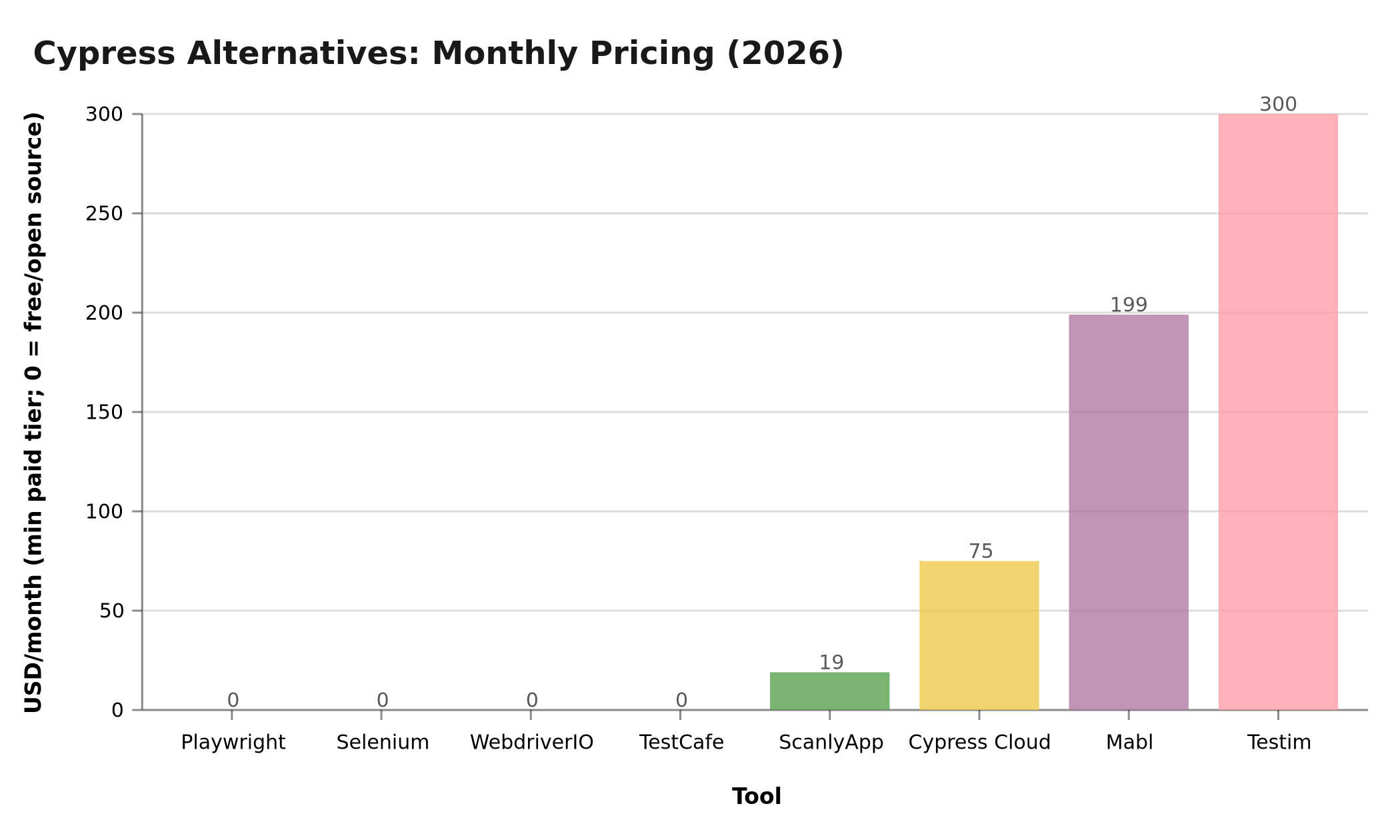 Figure: Starting monthly cost for a 3–5 person QA team. Open-source tools show cost at zero; Cloud/managed platforms show lowest paid tier. Data: vendor pricing pages, April 2026.
| Tool | Free Plan | Entry Paid Cost | Language Support | Parallel Execution |
|---|---|---|---|---|
| Cypress | ✓ (limited Cloud) | $75/month (Cloud Starter) | JS / TypeScript only | Cloud-only |
| Playwright | ✓ (always free) | $0 | JS, TS, Python, Java, C# | Native (no Cloud) |
| ScanlyApp | ✓ | $29/month (managed platform) | Playwright-native | ✓ managed |
| WebdriverIO | ✓ (always free) | $0 | JS / TypeScript | Via Selenium Grid |
| Selenium | ✓ (always free) | $0 | All major languages | Via Grid |
| Testsigma | ✓ | $499/month | Natural language/visual | ✓ cloud |
| TestCafe | ✓ (always free) | $0 (StudioPro paid) | JS / TypeScript | ✓ built-in |
| Robot Framework | ✓ (always free) | $0 | Keyword-based / Python | Via Pabot plugin |
Feature Radar: Cypress vs ScanlyApp
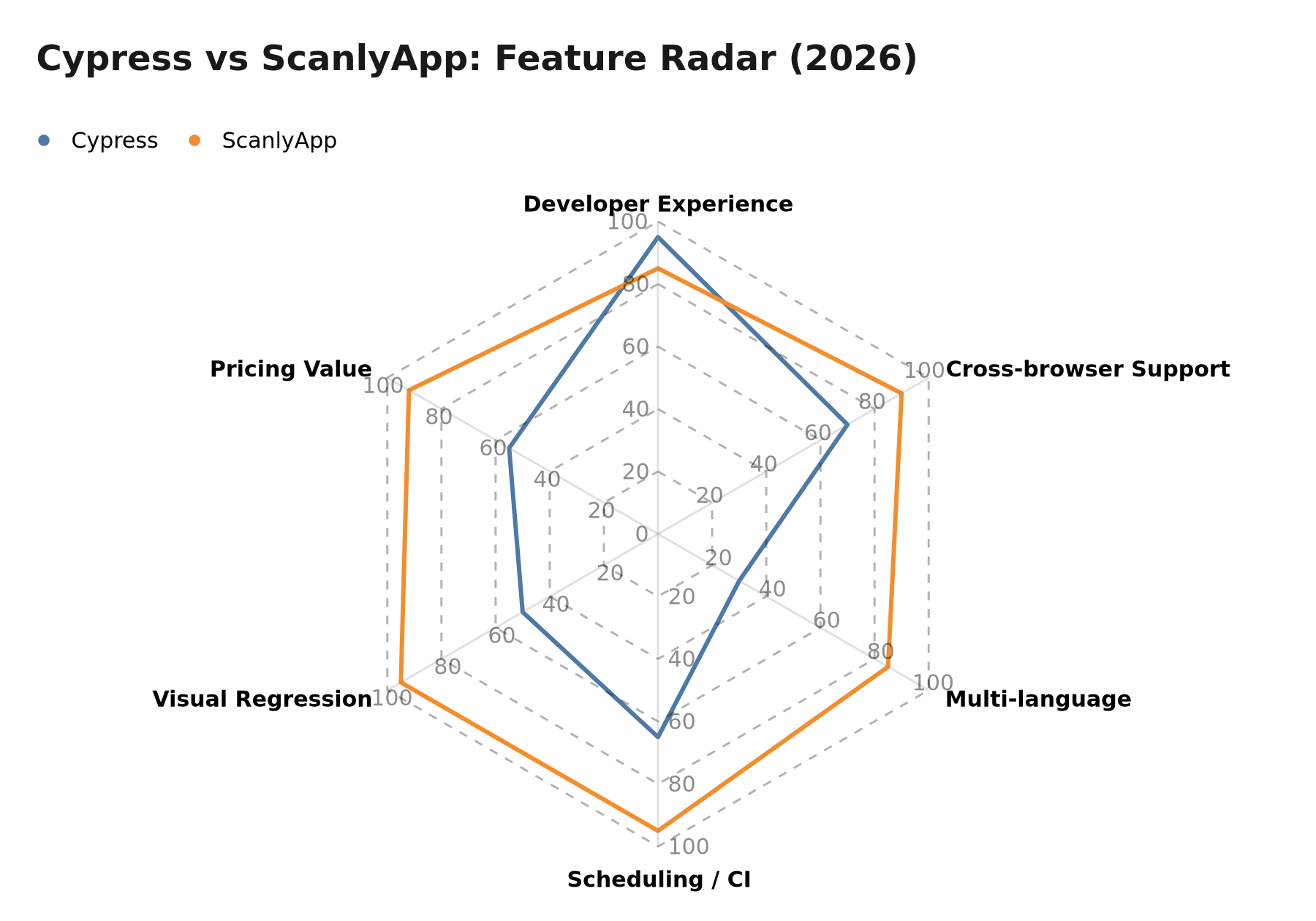 Figure: Feature scores (0–100) for Cypress Cloud vs. ScanlyApp across Developer Experience, Cross-Browser Coverage, Scheduling, Visual Regression, Pricing Value, and Non-Dev Dashboard. April 2026.
Total Cost of Ownership
The infrastructure and training costs often dwarf the licensing fees for open-source tools:
- Playwright: $0 licensing + infrastructure ($6,000–$18,000/year for CI) + training ($26,400–$48,000/year for a dedicated engineer) = $32,400–$66,000/year
- Cypress (with Cloud): $900–$3,000/year (Cloud) + infrastructure + training = $41,400–$102,000/year
- Selenium: $0 licensing + higher infrastructure + higher training (older dev experience) = $64,400–$142,000/year
- Playwright + ScanlyApp: $228/year (ScanlyApp) + lower infrastructure (execution is managed) + same training = $28,000–$58,000/year
Choosing Your Cypress Alternative
flowchart TD
    A[Leaving Cypress] --> B{Why are you leaving?}
    B -- Cost of Cypress Cloud --> C[Keep tests, switch managed platform]
    B -- Language lock-in JS only --> D[Switch framework]
    B -- Need better cross-browser --> E[Playwright or ScanlyApp]
    C --> F[ScanlyApp - $29/mo managed Playwright execution]
    D --> G{Primary language?}
    G -- Python / Java / C# --> H[Playwright - multi-language]
    G -- JS/TS preferred --> I[Playwright or WebdriverIO]
    E --> F
    H --> J[Add ScanlyApp for scheduling + visual regression]
Further Reading
Related articles: