Top 8 Selenium Alternatives and Competitors in 2026
Selenium has been the backbone of web test automation for nearly two decades. But in 2026, teams are migrating away from it faster than ever — and for good reason. Slower execution, steep learning curves, brittle locator strategies, and the complete absence of built-in visual regression or scheduling have pushed engineers to look for modern alternatives.
According to data tracked by BetterStack, Playwright surpassed Cypress in npm weekly downloads in April 2025 while racking up 81,600 GitHub stars — a 235% year-over-year growth rate. This guide covers 8 verified Selenium alternatives evaluated in April 2026, with real pricing, capability trade-offs, and a clear recommendation for teams that want Selenium's power without its headaches.
Why Teams Are Leaving Selenium in 2026
Selenium's core problems haven't changed, but the bar has been raised:
- Steep learning curve — WebDriver protocol complexity forces teams to invest heavily in framework setup before writing a single meaningful test.
- High maintenance burden — Flaky waits,
StaleElementReferenceExceptionerrors, and brittle CSS selectors consume significant engineering time. - No built-in features — No test runner, no assertions, no parallel execution out of the box. You must bolt on TestNG, JUnit, or PyTest plus a grid.
- Slow execution — Selenium 4 improved things, but it still lags 2–3× behind Playwright on modern web apps according to multiple 2025 benchmark analyses.
- Zero visual regression support — You have to integrate Applitools or a custom solution to catch visual regressions.
If any of these pain points have hit your team, one of the alternatives below likely solves them.
The 8 Best Selenium Alternatives in 2026
1. ScanlyApp ⭐ Editor's Pick
Best for: Teams that want managed cloud QA scanning, scheduling, and visual regression without building or maintaining their own test infrastructure.
ScanlyApp is an advanced cloud-based QA platform that handles what Selenium deliberately doesn't: scheduled runs, cloud parallel execution, visual diff tracking per run, an executive summary with severity breakdown, and a non-developer dashboard for QA managers and stakeholders. Where Selenium requires you to assemble a grid, configure parallel workers, and build your own reporting pipeline, ScanlyApp gives you all of that in a single product starting at $29/month.
Head-to-head: Selenium vs ScanlyApp
| Feature | Selenium | ScanlyApp |
|---|---|---|
| Browser engine | WebDriver protocol | Multi-browser cloud + self-hosted Docker |
| Language support | Java, Python, C#, JS, Ruby | JS/TS scan configs + API-driven triggers |
| Visual regression | ✗ | ✓ pixel-diff per run |
| Scheduling | ✗ (via CI only) | ✓ cron + on-demand + CI-triggered |
| Parallel execution | Requires Selenium Grid | ✓ built-in |
| Non-dev dashboard | ✗ | ✓ |
| Self-hosted option | ✓ Grid | ✓ Docker |
| Pricing start | Free | $29/month |
| Free plan | ✓ (open source) | ✓ |
| API testing | ✗ | ✓ |
Pricing: Starter $29/month · Growth $79/month · Pro $199/month. Per-project model — no per-seat charge means the whole team (plus QA managers) can log in without blowing the budget.
Verdict: If you're maintaining a Selenium suite and finding yourself spending more time on infrastructure than on writing tests, ScanlyApp is the shortest path to a modern cloud QA platform: scheduled scans, visual regression, Lighthouse performance tracking, and an executive dashboard — all without managing a grid yourself.
2. Playwright
Best for: Engineering teams that want the most capable open-source browser automation framework available today.
Playwright is Microsoft's answer to every Selenium limitation. It uses a direct browser protocol connection (bypassing WebDriver entirely), executes tests 2–3× faster than Selenium on modern SPAs, and ships with first-class support for Chromium, Firefox, and WebKit out of the box. In April 2025 it overtook Cypress in npm weekly downloads — a clear signal of mass adoption.
Pricing: Free and fully open source.
Key advantages over Selenium:
- Auto-waits eliminate most flakiness (no manual
sleep()or explicit waits) - Trace viewer + video recording built-in for every failing test
- Multi-language: JS/TS, Python, Java, .NET/C# — all first-class
- Native parallel test execution via multiple browser contexts
page.route()for network interception — no extra proxy needed
Limitation vs ScanlyApp: Playwright is a framework, not a managed platform. You still need to handle scheduling, cloud execution, parallelism at scale, and reporting — or integrate with a service like ScanlyApp.
3. Cypress
Best for: JavaScript/TypeScript front-end teams that prioritize developer experience and in-browser debugging.
Cypress runs tests inside the browser process (not via WebDriver), giving it a uniquely powerful debugging experience: time-travel snapshots, real-time test re-execution, and direct access to the app's JavaScript environment. For React/Vue/Angular SPAs with complex client-side state, Cypress's ability to directly stub fetch calls and manipulate JS globals is hard to beat.
Pricing: Free for local testing. Cloud from $75/month (Starter), $250+/month for teams with parallelism needs.
Limitation vs Selenium: JS/TS only. If your team uses Java, Python, or C#, Cypress isn't an option. Also, Cypress's cross-browser support historically lagged (though WebKit support has improved in v13+).
4. WebdriverIO
Best for: Node.js teams that want WebDriver protocol compatibility with a significantly better developer experience than raw Selenium.
WebdriverIO wraps the WebDriver protocol in a clean async/await API, provides a built-in test runner, and integrates with popular assertion libraries and reporters. It supports both WebDriver (for legacy grid compatibility) and Chrome DevTools Protocol (for speed). Teams already invested in Selenium Grid infrastructure can reuse it while migrating to a modern authoring experience.
Pricing: Free and open source. G2: 4.3/5, TrustRadius: 9.6/10.
Best use case: Teams with existing Selenium Grid + Java/Node infrastructure that want to modernize the test authoring layer without rebuilding the entire stack.
5. TestCafe
Best for: Language-agnostic teams that want zero-configuration cross-browser testing.
TestCafe takes a different architectural approach: it injects JavaScript into the page and proxies browser traffic, so it doesn't need any browser driver installation. This makes setup near-instant. Tests run in a real browser without WebDriver.
Pricing: Free and open source (Developer Tools edition). DevExtreme license required for some enterprise features.
Strengths:
- Verifies existence and DOM readiness automatically (fewer waits)
- Role-based authentication helpers simplify multi-user scenario testing
- Concurrent test execution out of the box
Limitation: Smaller community than Playwright or Cypress. Less active development compared to 2024.
6. Robot Framework
Best for: Teams that prefer keyword-driven, human-readable test scripts — especially QA teams with non-developer members.
Robot Framework uses a tabular, keyword-driven syntax that non-programmers can read and modify. Its extensive library ecosystem (SeleniumLibrary, Browser Library using Playwright, RequestsLibrary) makes it adaptable to UI, API, and RPA testing. The Python-based core integrates cleanly with CI/CD pipelines.
Pricing: Free and open source.
Limitation: The extra abstraction layer can slow down test execution and make it harder to debug low-level browser interactions compared to Playwright or Cypress.
7. Katalon Studio
Best for: QA teams that need a low-code alternative with record-and-playback capabilities.
Katalon Studio wraps Selenium and Appium in an IDE with a visual test recorder, making it accessible to testers without strong programming backgrounds. The enterprise tier adds AI-powered self-healing locators. Web, mobile, API, and desktop testing in a single platform.
Pricing: Free tier available. Pro from ~$60/month. G2: 4.4/5.
Limitation: The IDE is heavyweight and slow compared to VSCode-based workflows. The free tier has significant feature caps.
8. Appium
Best for: Teams that need to extend mobile automation to match their web testing stack.
Appium brings the WebDriver protocol to iOS and Android native apps. If your Selenium web tests need a mobile testing companion — and you want both to use the same protocol, the same language, and fit into the same CI pipeline — Appium is the logical extension.
Pricing: Free and open source.
Limitation: Not a Selenium replacement for web testing — it's a companion for mobile. Web teams that primarily need browser automation don't benefit from switching to Appium.
Pricing Comparison
 Figure: Lowest monthly paid tier across 8 tools. Free tiers shown as $0. Open-source tools are free in perpetuity. Data: vendor pricing pages, April 2026.
| Tool | Free Plan | Lowest Paid Tier | G2 / Rating |
|---|---|---|---|
| Selenium | ✓ (OSS) | Free | 4.2/5 |
| Playwright | ✓ (OSS) | Free | 4.7/5 |
| Cypress | ✓ (local) | $75/month (Cloud) | 4.7/5 |
| WebdriverIO | ✓ (OSS) | Free | 9.6/10 TR |
| TestCafe | ✓ (OSS) | Free | 4.4/5 |
| Robot Framework | ✓ (OSS) | Free | 4.5/5 |
| Katalon | ✓ (limited) | ~$60/month (Pro) | 4.4/5 |
| Appium | ✓ (OSS) | Free | 4.3/5 |
| ScanlyApp | ✓ | $29/month | — |
Feature Radar: Selenium vs. ScanlyApp
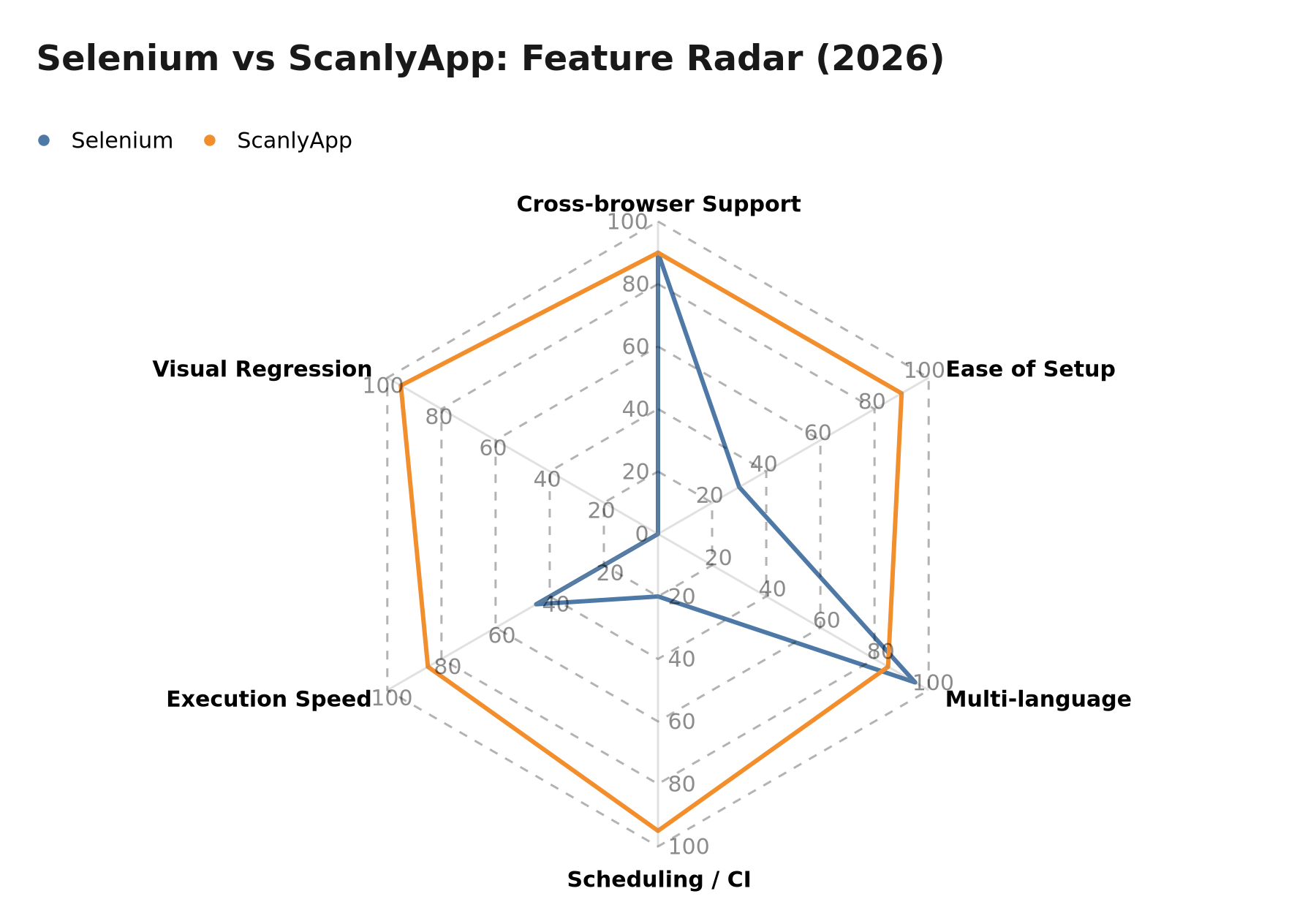 Figure: Feature scores (0–100) comparing Selenium and ScanlyApp across Cross-browser Support, Ease of Setup, Multi-language, Scheduling/CI, Execution Speed, and Visual Regression. April 2026.
Choosing the Right Selenium Alternative
flowchart TD
    A[Looking for Selenium alternative] --> B{Primary concern?}
    B -- Speed + modern API --> C{Multi-language needed?}
    B -- Low-code / no code --> D[Katalon Studio]
    B -- Mobile + web combo --> E[Appium + Selenium]
    B -- Managed platform --> F[ScanlyApp]
    C -- Yes JS/TS Python Java --> G[Playwright]
    C -- JS/TS only is fine --> H[Cypress]
    G --> I{Need scheduling + visual regression?}
    I -- Yes --> F
    I -- No, self-managed is fine --> G
Migration Guide: Moving from Selenium to Playwright
The most common migration path teams take is Selenium → Playwright (raw) or Selenium → ScanlyApp (if managed execution is the goal). Here's what to expect:
# Selenium (Python) — typical page interaction
from selenium import webdriver
from selenium.webdriver.common.by import By
from selenium.webdriver.support.ui import WebDriverWait
from selenium.webdriver.support import expected_conditions as EC

driver = webdriver.Chrome()
driver.get("https://example.com")
wait = WebDriverWait(driver, 10)
button = wait.until(EC.element_to_be_clickable((By.CSS_SELECTOR, "#submit")))
button.click()
# Playwright (Python) — equivalent, with auto-wait
from playwright.sync_api import sync_playwright

with sync_playwright() as p:
    browser = p.chromium.launch()
    page = browser.new_page()
    page.goto("https://example.com")
    page.click("#submit")  # auto-waits for clickability
    browser.close()
The mechanical migration is straightforward: replace driver.find_element(By.CSS_SELECTOR, ...) with page.locator(...), drop explicit waits, and convert assertions to the Playwright API. What takes time is updating your CI pipeline, parallelisation config, and reporting setup — areas where ScanlyApp's platform handles the heavy lifting.
The Verdict
- For raw performance and modern API: Playwright is the clear winner.
- For JS/TS SPA debugging: Cypress.
- For keyword-driven, low-code: Robot Framework or Katalon.
- For the full package (execution + visual regression + scheduling + dashboard): ScanlyApp at $29/month gives you everything Selenium's ecosystem requires you to build yourself.
Further Reading
- Playwright official documentation
- Selenium deprecation of Selenium IDE (WebDriver BiDi migration)
- State of Testing 2025 — Automation trends
Related articles: