Top 8 Postman Alternatives and Competitors in 2026
Postman built the API testing market. In 2026, it still has 30 million users and the most comprehensive feature set in the API client space. But a series of polarising decisions — mandatory cloud sync for collaborative features, reduced free tier limits in 2023, performance degradation with large collections, and privacy concerns around cloud-stored credentials — have accelerated its replacement across many engineering teams.
The good news: the alternatives are exceptional. Bruno is arguably the best API client for teams that live in Git. Hoppscotch is the best browser-based option. Apidog covers the full API lifecycle. This guide covers 8 Postman alternatives evaluated in April 2026, with real pricing and honest comparisons.
Why Teams Are Moving Away from Postman in 2026
The shift isn't about capability — Postman remains highly capable. It's about trade-offs that became dealbreakers:
- Mandatory cloud sync for teams (2023 change). All collection data syncs to Postman's cloud servers. Teams with strict data handling requirements or security reviews can't use it without policy exceptions.
- Free tier restrictions. Post-2023, the free Postman tier limits collection collaboration and API mock calls in ways that force team upgrades.
- Performance with large collections. Teams running 1,000+ request collections report noticeable UI lag and slow collection loading.
- Collection size limits on free and lower-paid tiers.
- Pricing at scale. The Team plan at $49/month (5 users) scales to $12/user/month — expensive for large teams compared to alternatives.
The 8 Best Postman Alternatives in 2026
1. ScanlyApp ⭐ Editor's Pick (For Scheduled API Monitoring)
Best for: Teams that want their API tests to run on a schedule against production (or staging) — combined with browser E2E and visual regression in a single platform.
Postman is purpose-built for manual API exploration and one-off collections. ScanlyApp is purpose-built for continuous API health monitoring — the same assertions you'd write in Postman, running on a cron schedule, with alerting when a response changes unexpectedly, all visible in a non-developer dashboard.
Where ScanlyApp fits vs. the Postman ecosystem:
| Use Case | Best Tool |
|---|---|
| Interactive API exploration | Bruno or Hoppscotch |
| Team collaboration on collections | Apidog or Postman |
| Scheduled API health monitoring | ScanlyApp |
| API docs + mock server | Apidog |
| Offline-first, Git-native storage | Bruno |
| Quick one-off requests | cURL / HTTPie |
| Full browser E2E + API monitoring | ScanlyApp |
Pricing: Starts at $29/month (Starter). Growth $79/month, Pro $199/month. Free plan available.
Verdict: If you're using Postman Monitor (Postman's scheduling feature, from $49/month with a team plan), ScanlyApp replaces it at a lower cost while adding full automated browser scanning, visual regression, and Lighthouse performance monitoring to the same monitoring schedule.
2. Bruno
Best for: Teams that want Git-native API collections with zero cloud dependency.
Bruno has been the fastest-growing Postman alternative in 2025–2026. Its core differentiator: collections are stored as plain files in your repository (bruno.json and .bru files), which means every change is diffable, reviewable in PRs, and auditable in git history. There's no cloud sync, no mandatory account, and no privacy concerns about API credentials being stored on third-party servers.
Pricing: Free and open source. Paid "Bruno Safe" tier planned for enterprise credential management.
Key advantages over Postman:
- Fully offline — no account required
- Git-native collection format (
.brufiles are human-readable) - Fast and lightweight (no Electron performance tax)
- No vendor lock-in on collection format
Limitation: Less polished UI than Postman. No built-in API documentation generation.
3. Hoppscotch
Best for: Teams that want a fast, browser-based API client with no installation required.
Hoppscotch is fully open source and runs in the browser. It supports REST, GraphQL, WebSocket, Server-Sent Events, and Socket.IO — a broader protocol range than most clients. Real-time collaboration is built-in. For teams where "install Postman on every dev machine" is a friction point, Hoppscotch's browser-based approach eliminates the onboarding step entirely.
Pricing: Free (cloud). Self-hosted option available. Enterprise plans for teams.
Key advantages: Zero installation, broad protocol support, clean minimalist UI, active open-source community.
4. Insomnia (Kong)
Best for: Teams with GraphQL-heavy APIs and strong git workflow integration.
Insomnia by Kong is the polished, developer-focused alternative to Postman. Its Git Sync feature stores collections directly in your repository (similar to Bruno but more UI-polished). GraphQL introspection and schema support are best-in-class among GUI clients. The Pro tier adds team workspaces and real-time collaboration.
Pricing: Free tier. Pro at $5/user/month. Enterprise custom pricing.
Where it excels: Environment variable management, request chaining for complex auth flows, GraphQL IDE integration.
5. Apidog
Best for: Teams that want an all-in-one API platform covering design, documentation, mocking, and testing in one product.
Apidog combines what teams typically spread across multiple tools: API design (OpenAPI/Swagger editor), documentation generation, mock server, test suite, and collaborative client. It positions itself as the single replacement for Postman + Swagger Editor + Mock Server.
Pricing: Free plan. Basic at ~$9/user/month. Enterprise at ~$324/user/year.
Key feature: The API design → documentation → test lifecycle in one UI means no context switching between tools.
6. Thunder Client
Best for: Teams that want an API client integrated directly into Visual Studio Code.
Thunder Client is a VS Code extension that brings a Postman-like interface directly into the IDE. Collections, environments, and tests live inside VSCode. For teams that live in VS Code and resent switching to a separate Postman app, Thunder Client eliminates the context switch.
Pricing: Free (basic). Starter at $3/user/month. Business at $7/user/month. Enterprise at $16/user/month.
Limitation: Less capable than Postman for very complex collection structures or large-scale API automation.
7. HTTPie
Best for: Teams that prefer a CLI-based API client with human-readable output.
HTTPie is a command-line HTTP client with syntax highlighting, JSON formatting, and a readable request/response format that makes it significantly more usable than raw cURL. The desktop app provides a GUI shell around the same simplicity. For developers who write API scripts in shell pipelines, HTTPie's CLI output is much easier to parse than curl's raw output.
Pricing: Free CLI. Desktop app: free and paid tiers.
8. cURL
Best for: Every engineer's baseline API client — no installation needed.
cURL is already installed on every developer machine. It's the lingua franca of API requests — every API documentation example includes a cURL snippet. For quick one-off tests, it requires no setup.
Limitation: Not a team collaboration tool, no collection management, no environment variables beyond shell variables. Best used alongside a GUI client, not as a replacement.
Pricing Comparison
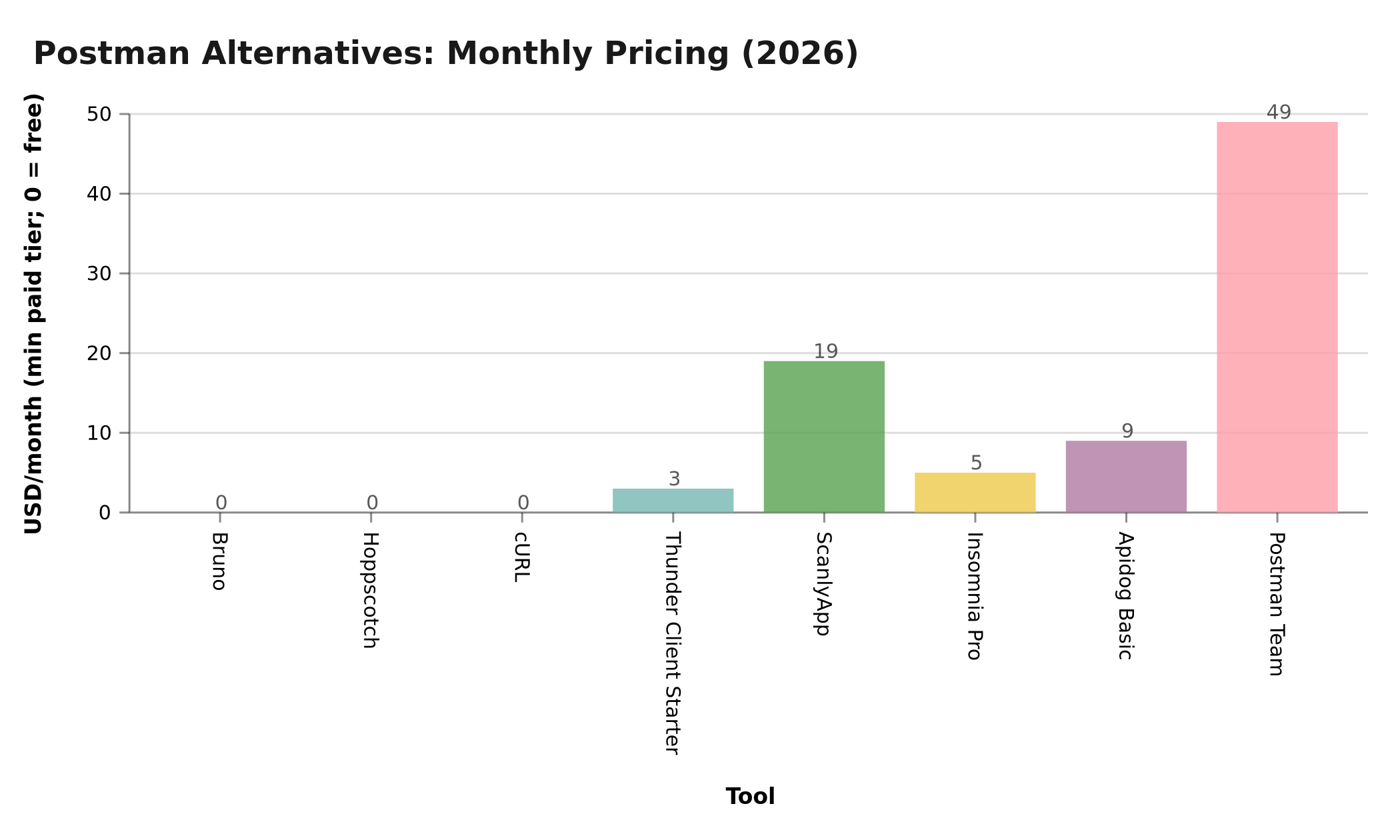 Figure: Lowest monthly paid tier per user or per project. Data: vendor pricing pages, April 2026.
| Tool | Free Plan | Lowest Paid Tier | Git-native? | Offline? |
|---|---|---|---|---|
| Postman | ✓ (limited) | $49/month (5 users) | ✗ | Partial |
| Bruno | ✓ (OSS) | Free | ✓ | ✓ |
| Hoppscotch | ✓ | Free (self-host) | ✗ | ✗ |
| Insomnia | ✓ | $5/user/month | ✓ | ✓ |
| Apidog | ✓ | ~$9/user/month | ✗ | ✗ |
| Thunder Client | ✓ | $3/user/month | ✗ | ✓ |
| HTTPie | ✓ | Paid desktop tier | ✗ | ✓ (CLI) |
| cURL | ✓ (free) | Free | ✗ | ✓ |
| ScanlyApp | ✓ | $29/month per project | ✗ | ✗ |
Feature Radar: Postman vs. ScanlyApp
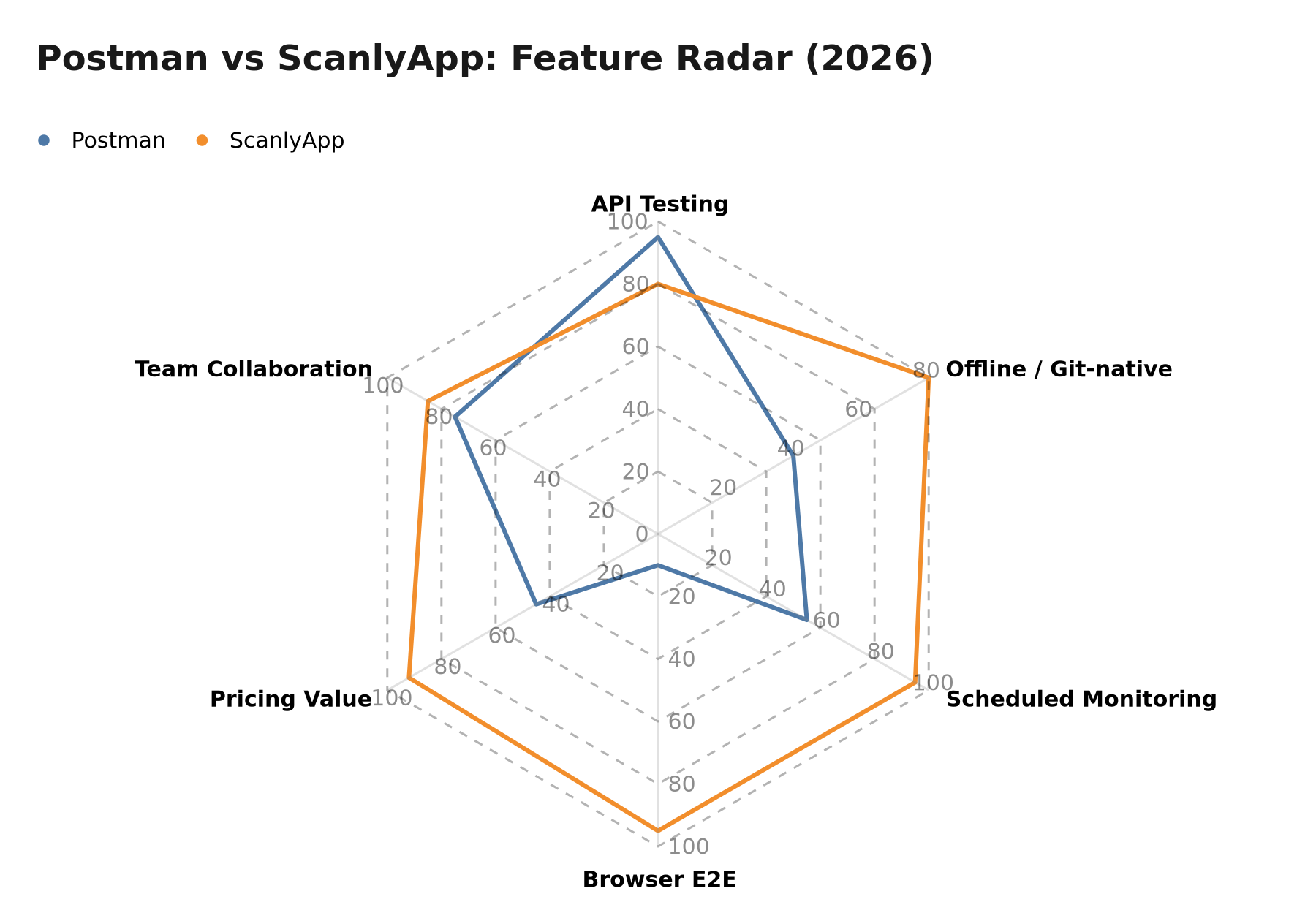 Figure: Feature scores (0–100) comparing Postman and ScanlyApp across API Testing, Offline/Git-native, Scheduled Monitoring, Browser E2E, Pricing Value, and Team Collaboration. April 2026.
Choosing the Right Postman Alternative
flowchart TD
    A[Looking for Postman alternative] --> B{Primary use case?}
    B -- Manual API exploration --> C{Prefer offline / Git-native?}
    B -- Scheduled API monitoring --> D[ScanlyApp]
    B -- Full API lifecycle: design + docs + mock + test --> E[Apidog]
    B -- IDE-integrated --> F[Thunder Client in VS Code]
    C -- Yes, offline + git --> G[Bruno]
    C -- Browser-based, no install --> H[Hoppscotch]
    C -- Polished GUI + GraphQL --> I[Insomnia]
    D --> J{Also need browser E2E?}
    J -- Yes --> D
    J -- API only --> K[Keep using API client of choice for manual testing]
The Bruno Advantage for Security-Conscious Teams
Bruno deserves specific attention for any team with security or compliance requirements. When you use Postman with team features, your API collections — including request headers, environment variable values, and potentially API keys — live on Postman's cloud servers. Postman's 2023 policy changes made this difficult to avoid without paying for on-premise options.
Bruno eliminates this entirely: your collections contain no secrets by default (.env files stay local and .gitignored), and the format is readable plain text that your security team can audit directly. For teams in regulated industries, this is often the decisive factor.
Further Reading
- Bruno documentation and getting started
- Hoppscotch self-hosting guide
- OpenAPI Specification (for API-design-first teams)
Related articles: