Top 8 Pingdom Alternatives and Competitors in 2026
Pingdom has been monitoring website uptime since 2007. For teams that need simple "is my site up?" alerts with a 1-minute check interval, it remains a perfectly functional choice. But the landscape has shifted dramatically: in 2026, you can get uptime monitoring, incident management, status pages, Playwright-backed browser checks, and visual regression — all for less than Pingdom's paid tier.
This guide covers 8 Pingdom alternatives evaluated in April 2026, with granular pricing and a clear recommendation for teams that want synthetic monitoring to do more than just ping a URL.
Why Teams Look for Pingdom Alternatives
Pingdom's limitations are primarily about value for money and missing features that competitors standardised on:
- Owned by SolarWinds. The 2020 SolarWinds supply chain attack shook confidence in SolarWinds-managed products. While Pingdom (a separate product) was unaffected technically, procurement conversations became harder.
- Price for what you get. Pingdom starts at $10/month for 10 monitors with 1-minute checks. For the same price, UptimeRobot gives you 50 monitors, and OneUptime gives you unlimited monitors on a free tier.
- No Playwright or browser scripting at lower tiers. Transaction monitoring (browser automation) is available, but requires higher-tier plans and uses Pingdom's proprietary recorder — you can't bring existing Playwright scripts.
- No incident management built-in. Unlike Better Stack or OneUptime, Pingdom doesn't handle on-call rotations, escalation policies, or incident timelines.
- No visual regression. Pingdom monitors availability and response time — it has no concept of visual state comparison.
The 8 Best Pingdom Alternatives in 2026
1. ScanlyApp ⭐ Editor's Pick
Best for: Teams that want advanced automated synthetic monitoring + visual regression + API checks in a single platform — at a Pingdom-comparable price.
ScanlyApp does what Pingdom's transaction monitoring promises but doesn't deliver at accessible price points: run full automated browser scans against your live app on a schedule, compare screenshots for visual regressions, and test API endpoints — all from a dashboard non-engineers can navigate without help.
Head-to-head: Pingdom vs ScanlyApp
| Feature | Pingdom | ScanlyApp |
|---|---|---|
| Uptime / HTTP checks | ✓ | ✓ |
| Browser scripting | Proprietary recorder | ✓ full automated scan scripts |
| Visual regression | ✗ | ✓ pixel-diff per run |
| Scheduling | Fixed intervals | ✓ cron + on-demand + CI-triggered |
| Incident management | Basic alerting only | Alerting (Slack, webhook, email) |
| Non-dev dashboard | ✓ | ✓ |
| Self-hosted option | ✗ | ✓ via Docker |
| API testing | Basic HTTP status | ✓ full request/response testing |
| Free plan | ✗ | ✓ |
| Pricing start | $10/month (10 monitors) | $29/month per project |
Pricing: Starter $29/month · Growth $79/month · Pro $199/month. Per-project pricing — no per-monitor or per-seat charges.
Verdict: For teams paying for Pingdom's transaction monitoring tier ($40+/month), ScanlyApp delivers the same coverage with full multi-browser scanning, visual regression, Lighthouse performance tracking, and API monitoring in a single subscription costing half as much.
2. Better Stack
Best for: Teams that want uptime monitoring plus incident management plus status pages in one product.
Better Stack is the most complete observability-plus-incidents product below the Datadog/New Relic price tier. Synthetic checks run from globally distributed locations. The standout feature: full incident lifecycle management (on-call schedules, escalation policies, incident status pages) is built-in — no need for a separate PagerDuty subscription.
Pricing: From $29/month (50 monitors). Includes status pages.
Key advantage over Pingdom: Incident management is first-class, not bolted on. For teams regularly paged at 2am for site outages, the built-in on-call rotation is worth the price difference alone.
3. UptimeRobot
Best for: Budget-conscious teams that need basic uptime monitoring with minimal friction.
UptimeRobot is the most widely-used free uptime monitor. The free tier gives you 50 HTTP monitors at 5-minute intervals. Paid plans ($7/month) increase the limit to 50 monitors at 1-minute intervals.
It doesn't compete on browser automation or visual regression — but for teams that primarily need "is my API returning 200?" alerts without any test scripting, it's an excellent free starting point.
Pricing: Free (50 monitors, 5-min interval). Pro from $7/month (1-min interval).
4. OneUptime
Best for: Teams that want a fully open-source uptime + incident + on-call + APM platform.
OneUptime is genuinely open source and self-hostable — the rare alternative that gives you full data ownership with no vendor lock-in. The cloud plan includes a free tier (unlimited monitors on the community plan), and the paid plan at $22/month adds more monitoring locations, incident management, status pages, and on-call scheduling.
Pricing: Free (community plan). $22/month (paid).
Key differentiator: Self-hosting is first-class, not an afterthought. For teams in regulated industries or with strict data residency requirements, this is often the decisive factor.
5. Checkly
Best for: DevOps and platform engineering teams that want monitoring-as-code with native Playwright support.
Checkly is purpose-built for developer-first synthetic monitoring. Checks are JavaScript files you commit to your repository. Playwright scripts can be promoted directly from your test suite to production monitoring. The tight git integration is compelling for teams already doing everything-as-code.
Pricing: Free tier (100k API runs/year). Team plan from $64/month.
Limitation vs ScanlyApp: Checkly is code-first only. Non-developers can't create or modify checks. There's no visual regression built-in.
6. Site24x7
Best for: Teams that want a full-stack monitoring suite (web + server + cloud + network) in a single platform.
Site24x7 covers synthetic monitoring, real user monitoring (RUM), infrastructure monitoring, cloud monitoring (AWS/Azure/GCP), and network monitoring — all from one platform. For operations teams that want to consolidate multiple monitoring tools, Site24x7 is broader than Pingdom.
Pricing: From $9/month. No free trial.
7. New Relic Synthetics
Best for: Teams already on New Relic that want synthetic monitoring integrated with full-stack performance data.
New Relic Synthetics supports scripted browser tests (Selenium WebDriver dialect), API monitors, and ping monitors from 17 global locations. The 100GB free tier makes it accessible for smaller teams. Integration with New Relic APM makes root-cause analysis significantly faster — a failing synthetic check links directly to the APM trace.
Pricing: Free 100GB tier per month. Usage-based beyond that.
Limitation: Scripted monitors use Selenium WebDriver syntax — you can't bring existing Playwright tests without rewriting them.
8. StatusCake
Best for: Teams that want an affordable uptime monitor with a polished status page builder.
StatusCake provides uptime monitoring, page speed tests, SSL certificate monitoring, and customisable public status pages. The free tier includes 10 monitors. Paid plans ($20/month) increase monitor count, reduce check intervals to 1 minute, and add advanced alerting.
Pricing: Free (10 monitors). Pro from $20/month.
Pricing Comparison
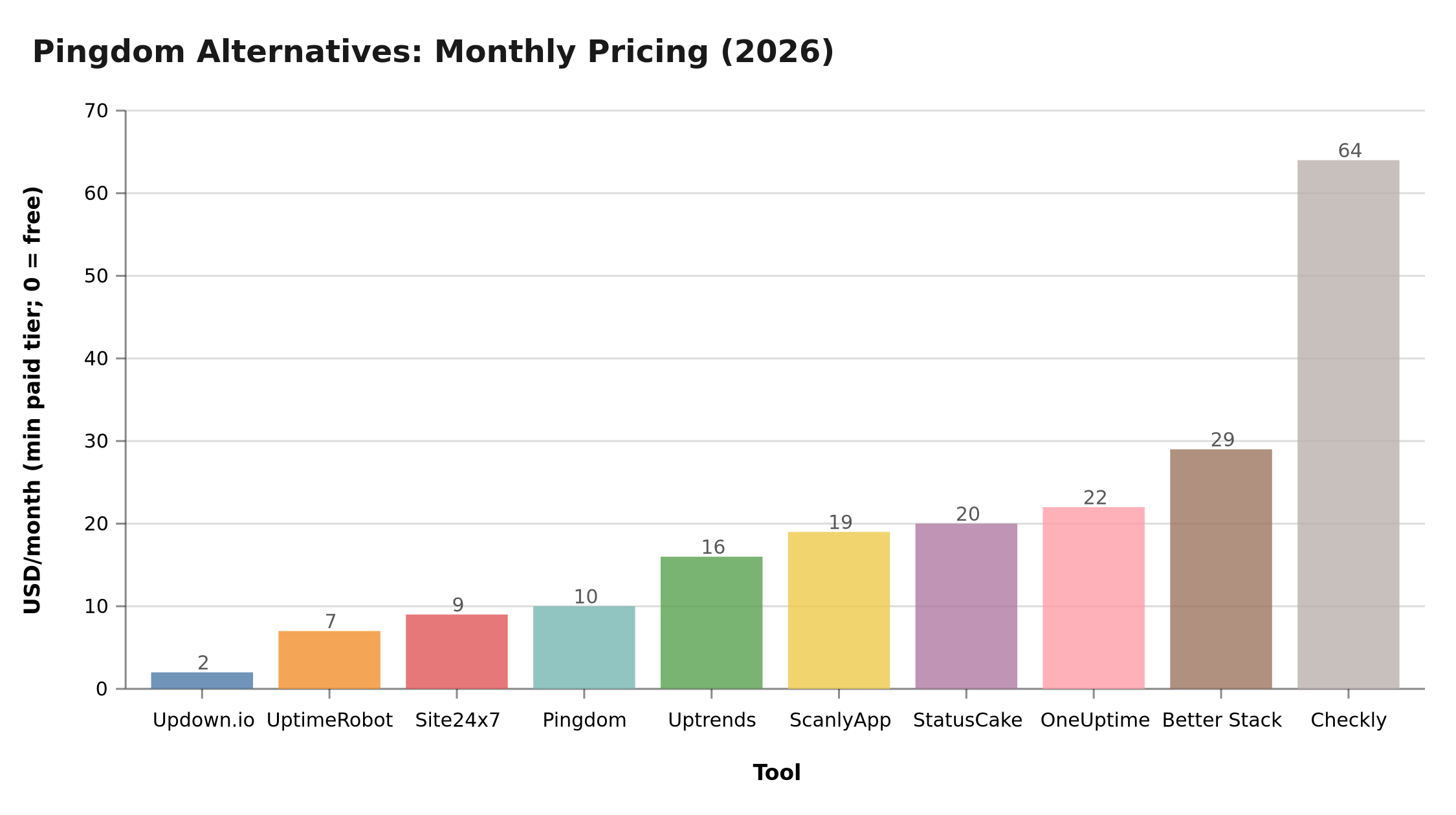 Figure: Lowest monthly paid tier across 10 tools. Data: vendor pricing pages, April 2026.
| Tool | Free Plan | Lowest Paid Tier | Playwright Support? | Visual Regression? |
|---|---|---|---|---|
| Pingdom | ✗ | $10/month | Proprietary recorder | ✗ |
| ScanlyApp | ✓ | $29/month | ✓ native | ✓ built-in |
| Better Stack | ✗ | $29/month | Basic | ✗ |
| UptimeRobot | ✓ (50 monitors) | $7/month | ✗ | ✗ |
| OneUptime | ✓ (community) | $22/month | ✗ | ✗ |
| Checkly | ✓ (100k API runs) | $64/month | ✓ (code-first) | ✗ |
| Site24x7 | ✗ | $9/month | ✗ | ✗ |
| New Relic Synthetics | ✓ (100GB/mo) | Usage-based | ✗ (Selenium) | ✗ |
| StatusCake | ✓ (10 monitors) | $20/month | ✗ | ✗ |
Feature Radar: Pingdom vs. ScanlyApp
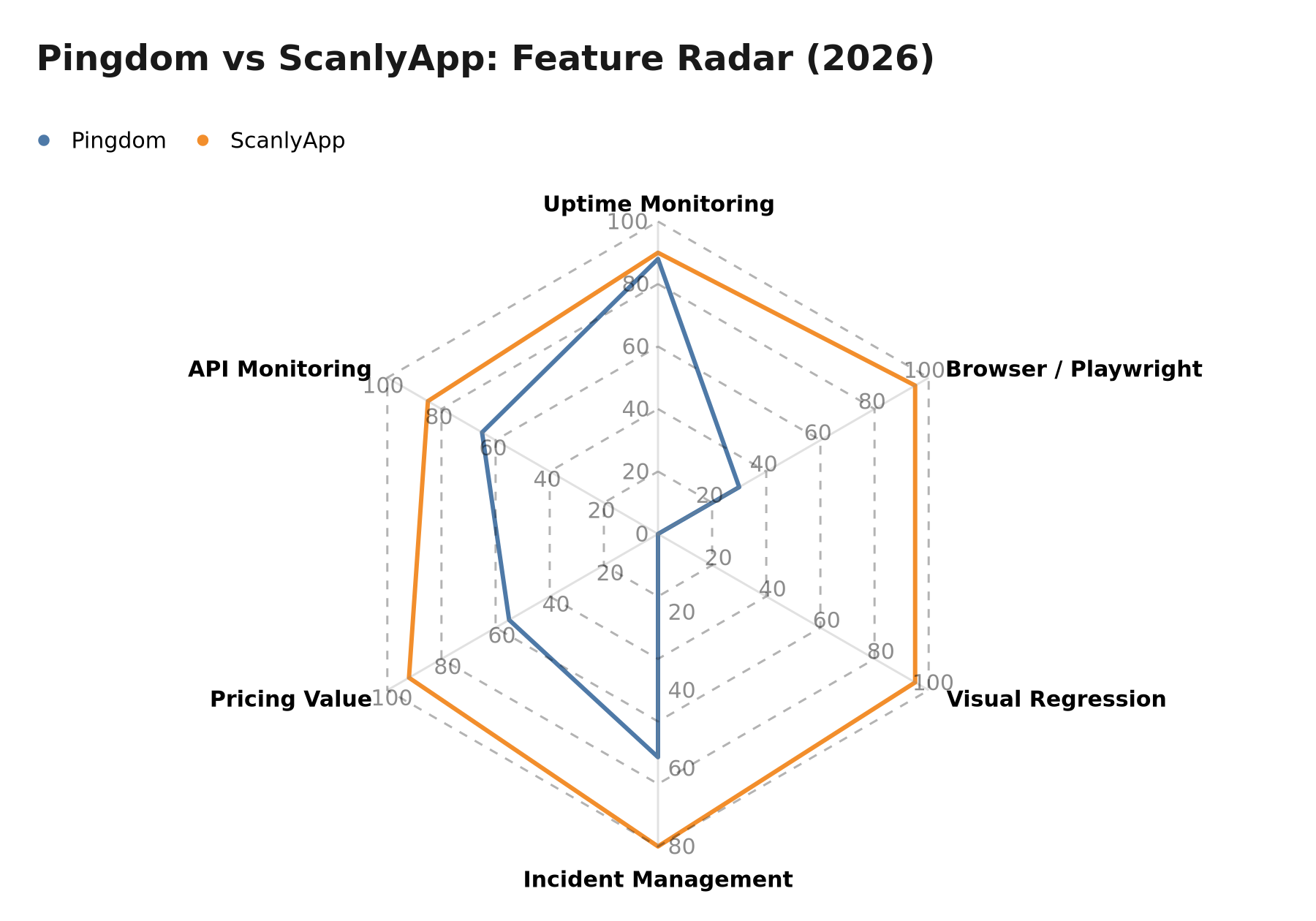 Figure: Feature scores (0–100) comparing Pingdom and ScanlyApp across Uptime Monitoring, Browser/Playwright, Visual Regression, Incident Management, Pricing Value, and API Monitoring. April 2026.
Choosing the Right Pingdom Alternative
flowchart TD
    A[Looking for Pingdom alternative] --> B{What's your primary need?}
    B -- Basic uptime alerts only --> C{Budget?}
    B -- Playwright browser tests on a schedule --> D[ScanlyApp or Checkly]
    B -- Incident management + on-call --> E[Better Stack or OneUptime]
    B -- Full-stack infra monitoring --> F[Site24x7 or New Relic]
    C -- Free or minimal cost --> G[UptimeRobot]
    C -- Some budget, want incident mgmt --> H[Better Stack]
    D --> I{Non-dev dashboard needed?}
    I -- Yes --> D
    I -- Code-first is fine --> J[Checkly]
Beyond Uptime: Why Synthetic Monitoring Needs Playwright
The most significant shift in website monitoring in 2026 is the move from "ping check" monitoring to full synthetic user journey monitoring. A ping check tells you your server is responding. A Playwright synthetic tells you your checkout flow, login page, or critical API path is actually working — not just responding with 200.
For SaaS products and e-commerce sites, the distinction is critical. An HTTP check will return 200 even when your cart's "Add to Checkout" button is broken by a JavaScript error. Only a real browser test catches that.
ScanlyApp's Playwright-native execution runs genuine user journeys on your schedule — turning your existing Playwright test suite into a production monitoring system without any rewriting.
Further Reading
- Checkly monitoring-as-code guide
- Better Stack incident management documentation
- Sematext synthetic monitoring overview
Related articles: